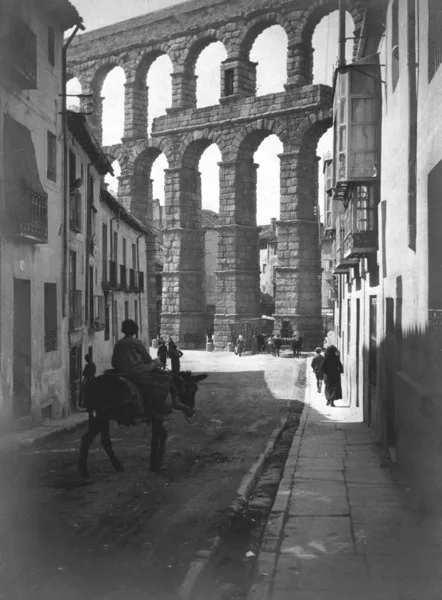
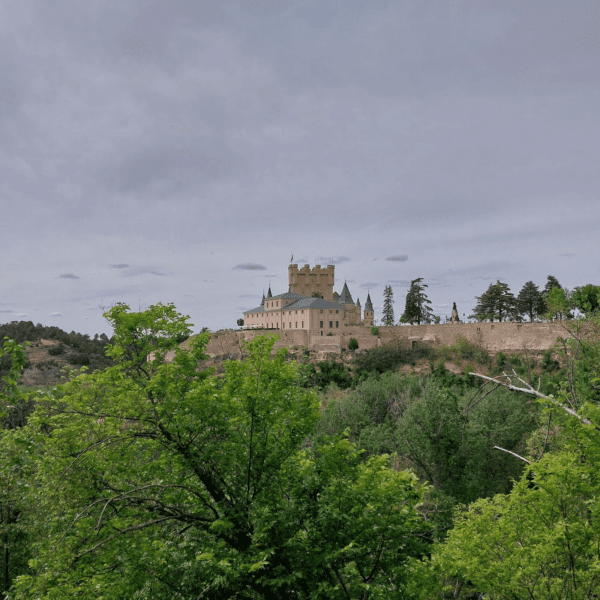
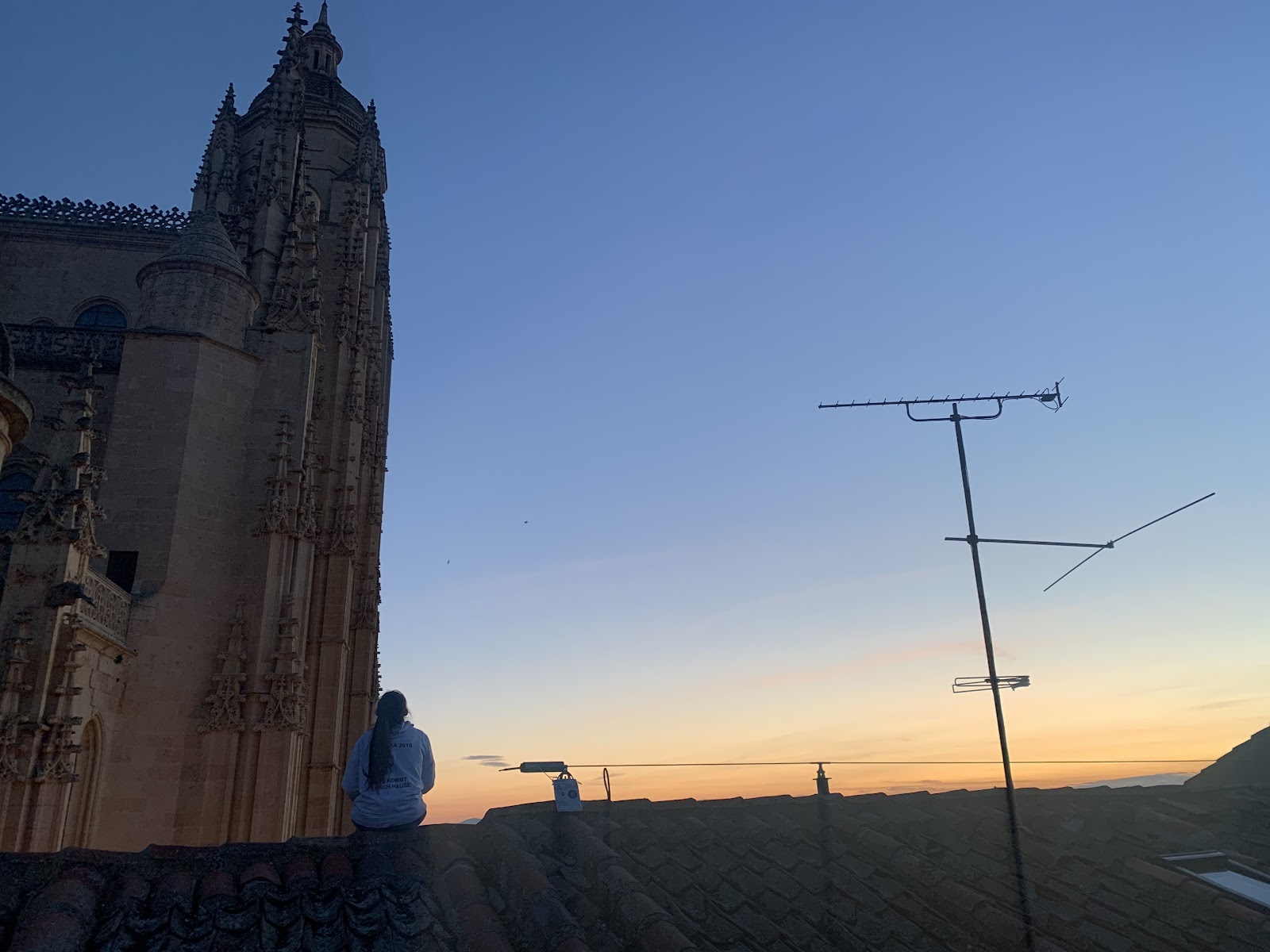
Segovia is undoubtedly beautiful, especially during the spring.
Being a UNESCO World Heritage Site, Segovia attracts tourists from all over the world. The cathedral, Plaza Mayor, and Aqueduct are some of the things that make this city so memorable – but there is so much more.
But what qualifies a place as a UNESCO World Heritage Site? The United Nations Educational, Scientific, and Cultural Organization has recognized the place as having outstanding value to humanity.
Therefore, as the shining sun and warm weather may bring out your inner explorer – here is a list of hidden gems around Segovia’s old town for your next walk while you take a break from finals:
House Museum of Antonio Machado
Image courtesy of Trip Advisor
Antonio Machado – a renowned Spanish poet, lived in Segovia from 1919-1931, where he taught French at the Instituto de Segovia. You can visit his home, now turned into the House Museum of Antonio Machado at Calle Desamparados 5.
The small picturesque house brings one back to another time. The re-furnished and remodeled home shows how the famous poet once lived. This is a great way to enjoy an afternoon, learn about Spanish history, and experience Segovia. Even if you don’t go into the museum, seeing the tiny home from the outside is worth seeing.
If you live in Segovia, there is no way you’ve missed this one.
Right in front of Carrefour Express sits la Casa de los Picos. It was commissioned in the XV century and is next to La Puerta de San Martin. Characterized by diamond-shaped ornaments, it was transformed into a home, seen by the five balconies.
Image courtesy of Castillos de España – @castillosdeespana.es
The building has gone through several uses. In the 70s, it homed the Ministry of Education, but since 1977, it has been part of the School of Applied Arts.
La Juderia
Image courtesy of Wikipedia
La Juderia, known as the Jewish Quarters, is a small neighborhood in Segovia’s old town.
It gets its name from the Jewish population that inhabited this area from the XII century until their expulsion through the Edict of Granada in 1492. It is located between Plaza Corpus Christi and the street la Juderia Vieja.
Emerge yourself in Segovian history as you walk around. Make sure you reach la Puerta de San Andres, which distinctively shows off the walls of Segovia. This door is also crucial as it is where the Jewish community was forced to leave.
Image courtesy of Segovia en buen plan
La Muralla
Segovia’s historic wall hides some beautiful views. They date from the XI to the XII century, and the best way to explore them is by walking!
Several paths go either around or inside the city walls. Although slightly farther from the city center and close to the IE Segovia Campus, check out Puerta de San Cebrián. You can go on top and get stunning views of our beloved Segovia campus.
Another beautiful place you need to check out by the city walls is called Senda de los Suspiros. If you continue walking down the street of the Alcázar – Rda. Don Juan III – you will find some steep staircases that take you down the walls. This beautiful and relatively easy hike leads you around las murallas while showing you the incredible views of the Alcázar and the cathedral. Make sure you bring hiking shoes!
Image courtesy of Christina Brusco
As finals season is approaching, make sure that you take breaks and go outside to get some fresh air: explore all of Segovia’s beautiful landmarks and pieces of rich history it has to offer.
Next time, maybe you will find your hidden treasures!
There really is no reason to continue highlighting how stressful finals season is. Students are flooded with multiple essays, projects, exams and for many it’s an overwhelming time period. Finding the motivation or even the willpower to study for finals is a pretty big challenge in itself. Below is a short list filled with tips and advice, in hopes of helping students make the whole studying process a little bit easier.
One: Figure out your optimal study time/ window
Figuring out your optimal study window is key. Ask yourself questions such as: At what time of the day do I work best in the morning or afternoon? When do I get least distracted? Some people who are considered early birds find it more practical to begin studying as soon as they wake up, it’s their prime time. However some people are night owls, these types of people tend to be more active during the night than the day- therefore if you consider yourself to be more efficient when working at night, you don’t need to force yourself to wake up incredibly early and vice versa. It’s all about time management and understanding what works best for you. And of course getting the assignment done.
Two: Restructuring a negative perception of studying into a positive one
One really useful tip or rather advice is to change your perception of studying. Oftentimes we hear students complaining about all the work they have to do and how much they have to study. In some cases, rightfully so. With that being said, studying can still be seen as something good, even something to look forward too. Afterall you get to learn more about your career and the degree you chose to study. Next time you think about studying, replace the negative connotation with something positive, hype yourself up, make studying a fun activity, act as you would when you’re about to do something exciting, and above all live with the idea or perception that studying is something to look forward to rather than dread having to do. Sometimes saying or thinking things as simple as “I’m so happy and can’t wait to study tonight!” instead of “Great… I’m forced to study tonight” can make a bit of a difference, with enough repetition, hopefully the message will sink in and studying will no longer be something to hate.
Illustration provided by: Bilicube
Three: Flame meditation
The flame meditation is quite simple and easy. You can use a lighted candle or simply play a youtube video of a lighted candle. The objective is to spend three to five minutes looking at the candle, focusing on the flames and breathing. This is supposed to help your concentration. Ideally you leave this short meditation, feeling more calmed and focused. This idea may sound silly to some, but sometimes it’s better to try something new for five minutes that could be helpful rather than spend the next forty minutes or more, trying not to procrastinate and getting distracted by anything else. You don’t lose anything by trying and best case scenario, it works!
Four: Take care of yourself
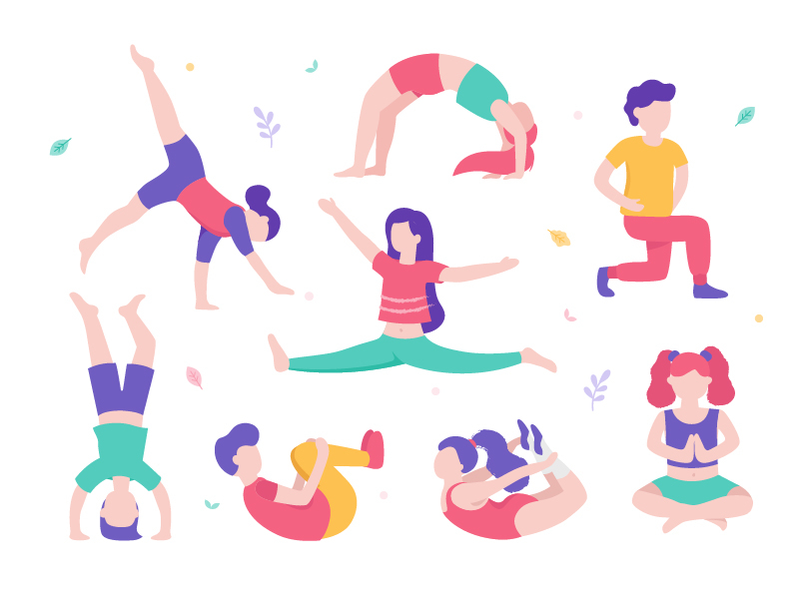
It is very important and highly encouraged that you take care of yourself and your well-being. How? For starters, getting enough sleep every night (ideally between seven and eight hours) and by making sure you are drinking enough water and eating good, nutritious food to help with that brain power you’ll use later when you’re studying. Exercising or at least moving your body is not only great for your physical health, but it’s also an easy way to clear your mind and a good way of spending your study break. Whether that be by going on a short walk or even doing a ten minute workout video, it counts.
Five: Have a clean and organized study area
This one is probably a common tip you’ve heard before but it’s still a goodie. Having a clean and organized study area. Even if the only area in your room that is organized is your desk, it will help. For effective studying, many people find that having a designated workspace is key. Why? You can remove distractions, keep or have everything you need such as good lighting, you can eliminate distractions, and above all have a quiet place where you can actually get work done.
Illustration provided by: Frikkkkkk
Six: Set binaural beats or listen to music that won’t distract you
If you’re the type of person who listens to music while you study, then it would be a good idea to select music that helps with concentration. Studies have shown that listening to binaural beats, nature sounds, and instrumental music can improve your focus and sets the tone for a good study session. Personally, I recommend listening to classical music, though music taste ranges drastically, therefore if you’re gonna listen to music while studying, ideally select music that encourages you to study and stay in the zone, rather than start your own dance party.
Seven: Take your video lecture notes on your phone
As a result of the pandemic, many professors have relied on video lectures. There are some pros to this as they allow students to revisit and revise what was discussed in class plus further add to the topic, however sometimes these lectures can often be long and take up a lot of time. If you are the type of person who takes notes during lectures, try taking notes on your phone, you can either use the notes apps, google doc app, or any other method. All you do is put your phone on airplane mode to avoid distracting notifications, watch your lecture, and begin texting/ typing your notes. This to an extent can also satisfy your need for using your phone.
Hopefully these tips and advice will further help you improve your studying, leading you down the path of passing all you’re exams. Studying and revising is a great way to prepare, though it should be done in moderate balance rather than intense cramming sessions. With that being said best of luck to everyone this finals season!
January 30: As some of the most severe fighting, including casualties and damage to infrastructure, continues in the eastern Donetsk region, Russian forces are expected to move to Lyman, Bakhmut, and Avdiivka. Russia continues to wait for the supply of ballistic missiles from Iran, making the Ukrainian Air Force state that they “do not have the means to defeat them.” Meanwhile, criticism from both Ukrainian and other global athletes sparked after the IOC announced the approval for Russian and Belarusian athletes to participate as “neutral athletes” in the 2024 Olympic Games.
October 29: In and out of Ukrainian battlefields, the Kremlin has started using Iranian Shahed-136 drones, with an attack on Kyiv killing four civilians October 24. As a result of Russian missile strikes on Ukraine’s energy grid, citizens across the country have been experiencing power shortages. As maintenance workers rush to avoid a deadly winter, Russia is evacuating tens of thousands of civilians from the occupied city of Kherson. The southern port city is not far from the Nova Kakhovka dam, the only land route that leads Russian troops safely back home. Meanwhile, the Russian defense ministry released a statement, accusing Ukraine of attacking its Black Sea Fleet in Crimea and, thus, suspending its involvement in the Black Sea Grain Initiative, signed in July.
October 14: On October 9, Ukrainian forces bombed Kerch Bridge, Russia’s only link to Crimea. Encouraged by domestic pro-war critics, Moscow responded by bombing civilian infrastructures in cities all over Ukraine, including Kyiv. In a national address on October 10, Russian President Vladimir Putin explained the attack was targeting “energy, military command and communications facilities of Ukraine.” As of now, the strategic bombing has not stopped Ukraine’s continuing advance on Russian-occupied territory. Meanwhile, Putin’s calls for more military conscripts have led tens of thousands to flee Russia, with most crossing over to Georgia.
October 1: Yesterday, Russian President Vladimir Putin announced Russia’s annexation of parts of Donetsk, Luhansk, Kherson and Zaporizhzhia, citing overwhelmingly supportive referendums. The West condemns this act as illegal, calling the referendums “fraudulent,” while Putin accuses this “enemy” of “despotism” and “Satanism.” Today, Ukrainian troops have claimed victory in the strategic rail hub city of Lyman, just after its recent annexation as part of the Donetsk province. Meanwhile, after the sabotage of the Nord Stream pipelines, the newly active Baltic Pipe shows promise of a Central European gas source independent of Russia, flowing directly from Norway.
September 23: As Ukraine’s southern counteroffensive now gains steam, Russia has announced that it will send 300,000 more of its soldiers into Ukraine. In addition, referendums on joining Russia are taking place in areas still under Moscow’s control. In regions like Luhansk, Ukrainian citizens are accompanied by armed Russian fighters as they cast their votes. Meanwhile, on September 21, Russian President Vladimir Putin declared that the Kremlin will “certainly use all the means at [its] disposal to protect Russia and [its] people,” sending shivers down Western spines, “It is not a bluff.” This was later echoed by Former Russian President Dmitry Medvedev, who included strategic nuclear weapons as a possibility. With Ukraine’s current referendums, what constitutes Russian territory in Moscow’s eyes remains to be seen.
September 15: Ukraine’s counteroffensive in the northeast continues. In the past week, Kyiv has reclaimed thousands of square miles of territory in the Kharkiv region, stretching until the key city of Izium. This rail hub now grants Ukrainian troops increased mobility between regions, all while depriving Moscow’s forces of a salient supply route. This is Ukraine’s greatest success since the beginning of the war. Meanwhile, at the Shanghai Cooperation Organization summit in Uzbekistan on September 14, Russian President Vladimir Putin spoke to Chinese President Xi Jinping and Indian Prime Minister Narendra Modi, both of whom expressed waning support for Putin’s war in Ukraine.
September 9: “In total, more than a thousand square kilometers of the territory of Ukraine have been liberated since the beginning of September,” said Ukrainian President Volodymyr Zelensky in last night’s national address, as Ukrainian officials claim to have made significant advances in the northeastern Kharkiv region this week. Meanwhile, the United Nations continues to denounce the shelling around the Zaporizhzhia nuclear power plant, seemingly to no avail. Today, in Brussels, EU Commission President Ursula von der Leyen is proposing policies to support the households that are facing crippling energy bills, due to Russia’s gas stoppage last week.
September 2: The region of Kherson has been occupied by Russia since February. This week, Ukraine’s counteroffensive has been making gains, conquering small towns in their path towards the main port city. However, Ukrainian officials are dreading the upcoming winter. On August 31, the Kremlin halted gas flows of its “Nord Stream 1” pipeline to Germany, citing maintenance issues. Now, Western European concerns on Russian dependency resurface, as European officials suspect the stoppage was politically motivated.
August 27: With a now stabilized ruble, Russia continues to shell Ukraine. On August 24 – Ukraine’s independence day – the Kremlin bombed a train station in southeastern Ukraine, killing 25 Ukrainians. Now, the back-and-forth accusations of shelling the Zaporizhzhia nuclear power plant have prompted the UN’s International Atomic Energy Agency to visit the facility, hoping to avoid nuclear disaster. Meanwhile, Ukrainian President Volodymyr Zelensky formed the “Kyiv Initiative,” an organization meant to strengthen cooperation and collective security in Eastern Europe and the Baltics. As of now, the Kyiv Initiative includes Ukraine, Poland, Estonia, Hungary, Latvia, Lithuania, Romania, and Slovakia.
August 18: After suffering many losses to Russian artillery, Ukraine has shifted its military strategy. Aided by local “partisans,” Kyiv’s forces are striking behind enemy lines, slowing Russia’s advances. Despite this, Moscow continues to display its strength in numbers, assuring experts that it possesses the offensive capabilities to keep moving forward. Meanwhile – while the Zaporizhzhia issue remains unsolved – United Nations Secretary General António Guterres is in the port city of Odesa, witnessing the first grain shipment to leave Ukraine, as per the deal signed by the warring parties in Istanbul last month.
August 11: Satellite imagery shows that Russia has lost about eight warplanes in an airbase in Crimea. However, after more than five and a half months of war, Moscow is imposing its dominance on many parts of southern and eastern Ukraine. In the city of Kherson, Russian forces have blocked all access to western-owned social media, and censored Ukrainian news. Russian news media is also documenting how its troops are building cages in the Mariupol Chamber Philharmonic, setting the building up for trials. Today, United Nations Secretary General António Guterres expressed his “grave concern” about the situation at Zaporizhzhia nuclear plant, as both parties continue blaming each other for the explosions.
August 5: The Kremlin has redeployed many of its troops to the Kherson region, sacrificing its advance on Slovyansk and Siversk to stop Ukraine’s counter-attack. Recently, explosions around Zaporizhzhia – Europe’s largest nuclear power complex – have raised safety concerns. Both sides are blaming each other for the incident. Meanwhile, in Sochi, Russia, Russian President Vladimir Putin and Turkish President Recep Tayyip Erdoğan are meeting face-to-face. Before talks started, Putin revealed he was open to discuss “security issues in the region, primarily the Syrian crisis.”
July 28: As Russian bombs hit Kharkhiv, Ukrainian forces are preparing for a counter-offensive in the Kherson region, in what national television describes as “a very powerful movement of their troops.” Moscow’s troops are fighting this with heavy artillery, although their resupply lines in the region were recently cut down by Ukrainian strikes. Meanwhile, after signing off on last week’s grain deal, Russian President Vladimir Putin signed a deal in Tehran, Iran, with President Ebrahim Raisi agreeing to supply Russia with aircraft parts.
July 21: Critical victories around the Dnipro river – partly thanks to Western-supplied long-range weaponry – have given Ukraine’s military a relative boost in confidence. “Russia can definitely be defeated and Ukraine has already shown how,” states Ukrainian Defense Minister Oleksiy Reznikov. In Istanbul, Turkey, a deal between the warring countries is set to be signed, with Moscow allowing grain to be exported through the Black Sea. Russia’s blockade has exacerbated food crises in Africa, where some countries relied on Ukraine for bread. Today, concerns of economic manipulation rose in Western Europe, as Kremlin-owned energy company Gazprom restarted the flow of gas to Germany.
July 14: Today, Russian bombs hit the west-central city of Vinnytsia, killing at least 23 Ukrainian citizens. “This day once again proved that Russia must be recognized as a terrorist state,” states Ukrainian President Volodymyr Zelensky, as officials search for missing bodies. The city had not been attacked since March, and did not pose any direct military threat to Moscow. Zelensky’s calls are heard in The Hague, where members of the International Criminal Court have agreed to pledge $20 million towards a collective investigation.
July 7: Ukraine is taking heavy losses in the Donbas. After occupying the Luhansk region, Russian troops have moved westward to the Donetsk region. Today, Russia intensified shelling in said region, resulting in seven civilian casualties in the city of Kramatorsk. Ukrainian Defense Minister Andriy Zagorodnyuk recently stated that his country’s military is facing a “moment of vulnerability.” Meanwhile, in Kyiv, US Senators Lindsey Graham and Richard Blumenthal finished their meeting with Ukrainian President Volodymyr Zelensky, and are willing to push their Congress to send more weapons to Ukraine.
June 30: Over the weekend, Sievierodonetsk was captured by Moscow, while Russian bombs hit cities outside the Donbas region, including Kyiv. This last move came as a surprise to the capital’s citizens, as the city had not been attacked in weeks. In the west, after sustained attacks, Ukrainian forces have taken back control of Snake Island. Meanwhile, NATO has expressed concern for their citizens’ weariness regarding the war. In Madrid, Swedish Foreign Minister Ann Linde stated “You can already see in the media that interest is going down, and that is also affecting the public, and the public is affecting the politicians.”
June 23: As Ukrainian forces continue to hold out in Sievierodonetsk’s ammonia plant, more and more Russian troops are encircling the city. In fact, Moscow is making steady advances in the Donbas region as a whole. Meanwhile, in Kyiv, Ukrainian flags fly alongside EU flags. Today, Brussels has given Ukraine and Moldova official candidate status, “mark[ing] a crucial step on [their] path towards the EU,” according to European Council President Charles Michel. This process can take up to 10 years, and is expected to irritate the Kremlin, which views Ukraine as part of its sphere of influence.
June 16: This past week, Ukrainian soldiers in Sievierodonetsk and Lysychansk have been struggling, with Russian troops continuing to make steady advances in the Donbas. While the eastern cities seem to be on their last legs, 1,200 Ukrainians have taken refuge at the Azov ammonia plant in Sievierodonetsk. Meanwhile, today, French President Emmanuel Macron, German Chancellor Olaf Scholz, and Italian Prime Minister Mario Draghi arrived in Kyiv, as Ukraine grows skeptical of the European Union’s support. In Madrid, NATO has solidified its stance against Russia, excluding it as a future partner.
June 9: As Russian shelling continues to kill Ukrainians in and around Kharkiv, military fighting has focused in on Sievierodonetsk. Though better armed, Russian troops have just suffered a Ukrainian counter-attack in the eastern city. Analysts proclaim that the Kremlin’s goal has shrunk, as Russia’s resources are funneled into the resource-rich Donbas region. Meanwhile, the United States’ Treasury has barred its citizens from buying Russian bonds or stocks, and the European Parliament has suggested that Ukraine be given candidate status in the European Union.
June 2: Local officials say Moscow controls most of Sievierodonetsk, though Ukrainian soldiers still fight on the streets. This brings Russia one step closer to seizing the entire Luhansk region. Meanwhile, the European Union has passed a ban on Russian oil imports arriving by sea, compromising with Prime Minister Viktor Orbán. This deal allows Russia to continue exporting oil to Hungary via pipeline, while the EU applies “maximum pressure on Russia to end the war,” as European Council President Charles Michel tweeted on May 31. Yesterday, Kremlin spokesman Dmitri Peskov denounced the United States for sending advanced rocket systems to Ukraine, describing it as “deliberately and painstakingly pouring gasoline on the fire” that is this conflict.
May 26: The military conflict is now focused on the Donbas. Moscow has redirected troops from northern Ukraine to the region, closing in on the key city of Sievierodonetsk. Experts expect Russian troops to seize Sievierodonetsk in similar fashion to Mariupol. In Brussels, hopes fade of an EU embargo on Russian oil, as Hungarian Prime Minister Viktor Orbán sticks to his decision. Meanwhile, negotiations for Finland and Sweden’s accession into NATO continue in Turkey, where President Recep Tayyip Erdoğan demands that Sweden cease its support for the separatist Kurdistan Worker’s Party.
May 19: As Ukrainian citizens return to a relatively quiet Kharkiv, the Kremlin tightens its grip on southern Ukraine, fortifying its defenses. Today, the Red Cross announced that Mariupol’s steel plant has fallen to Moscow. Meanwhile, Turkish President Recep Tayyip Erdoğan is blocking Finland and Sweden’s swift accession into NATO, demanding the organization resolve Kurdish security concerns in Turkey first. Similarly, Hungarian Prime Minister Viktor Orbán is stopping the EU from proceeding with its collective embargo on Russian oil, citing concern for potential economic repercussions on his country.
May 12: After failing to capture Kharkhiv, Russian troops are being re-routed to the southeastern province of Zaporiz’ka. There, the Kremlin has already taken the critical port of Berdyansk, while Ukraine still holds Zaporizhzhia, the province’s main city. Meanwhile, Finland has announced its decision to “apply for NATO membership without delay,” with Sweden soon to follow suit. Though accession could take more than a year, British Prime Minister Boris Johnson has pledged to defend Finland in case of any attack during this process. Moscow stated that it would “take necessary measures” to protect itself.
May 9: Today, Russian President Vladimir Putin made a patriotic speech at the annual “Victory Day” parade – which commemorates Russia’s victory in the Second World War – denouncing Ukrainians as “Nazis.” In Ukraine, most of occupied Mariupol held a similar parade, while local troops pushed Russian soldiers out of Kharkiv in the northeast. Meanwhile, the European Union’s planned embargo on Russian oil is delayed, as Hungary refuses to sign off on the pact.
May 2: Despite Russian shelling, the civilian evacuation of Mariupol is still underway. As hundreds of Ukrainians flee the nearly taken city, British intelligence suggests that Russia has suffered more losses than originally speculated, with 25% of invasion units being “rendered combat ineffective.” General Valery Gerasimov – Russia’s top uniformed officer – recently paid a visit to the eastern front-line to try to reverse this. Meanwhile, a month after Russia’s retreat from the area, citizens of Kyiv are starting to repopulate their streets, now accustomed to dealing with the occasional Russian missile strike.
April 29: Last night, Russian missiles struck Kyiv hours after a meeting between United Nations Secretary-General António Guterres and Ukrainian President Volodymyr Zelensky. While Russian troops make slow territorial gains in the eastern provinces of Donetsk and Luhansk, Ukraine’s military is sending more soldiers to Transnistria, the Kremlin-backed breakaway region in Moldova. Today, Britain has announced it will send 8,000 of its troops to support Ukraine, and United States President Joe Biden has asked Congress to approve the sending of a $33 billion aid package.
April 26: Russian President Vladimir Putin has agreed to maintain humanitarian corridors in besieged Mariupol, as United Nations Secretary-General António Guterres urged in their Moscow meeting. As western allies group together to send Ukraine more weapons, Russian and Ukrainian authorities blame each other for the bombing of Transnistria (internationally recognized as part of Moldova, but contested by the Kremlin as a breakaway region). Meanwhile, Russian gas giant Gazprom has announced that “unfriendly countries must pay gas in roubles,” targeting Poland and Bulgaria. While heavily dependent on Russian gas imports, both countries have refused.
April 23: Today, Ukrainian President Volodymyr Zelensky made a confident speech, celebrating the arrival of heavy artillery from sympathetic countries. He proclaimed “we will be able to show the occupiers that the day when they will be forced to leave Ukraine is approaching.” While missiles damage the southern city of Odesa, neither side has made any significant advances in the eastern front. In the meantime, United Nations Secretary-General António Guterres is on his way from Kyiv to Moscow. Having already spoken to Zelensky, Guterres is traveling in an effort to broker a peace deal.
April 20: As Russian artillery keeps raining down on eastern Ukraine, the Kremlin has successfully test-launched an intercontinental ballistic missile. Russian President Vladimir Putin declared that this would help Russia’s enemies “think twice” before interfering in the conflict. Ukrainian soldiers are still holding the southeastern port of Mariupol, where a deal was reached to evacuate women and children. Any readers looking to donate to Ukrainian businesses and charities can do so through this link.
April 17: As Ukrainians celebrate the sinking of Russian cruiser Moskva, Russian soldiers prepare to capture the strategic port city of Mariupol. Despite this, Ukrainian President Volodymyr Zelensky has encouraged his troops not to surrender, and warned that he will end peace talks if Russian forces continue to “deliberately [try] to destroy everyone who is there.” Meanwhile, in a national effort to reduce dependence on Russian fuel, Germany’s energy minister has rallied citizens to lower their home temperatures.
April 14: After seven weeks of fighting in besieged Mariupol, Russian troops have moved into the city center, dividing Ukrainian soldiers. As the Kremlin hopes to build a “land bridge” to Crimea by capturing the city, outnumbered Ukrainians still hold the peripheries. Moscow has also accused Ukraine of bombing Russian towns near the border, which Kyiv denies. Meanwhile, Austrian Chancellor Karl Nehammer comes back from Moscow with “no optimistic impression[s],” and EU officials are drafting a potential collective embargo on Russian oil products.
April 11: In the past two days, 13,400 Ukrainian civilians have evacuated Eastern Ukraine. As Russian troops prepared to attack the region, President Volodymyr Zelensky declared “We will respond.” Today, eastern cities like Kharkiv and Kramatorsk are updating their death tolls, in the wake of Russian missile strikes. Meanwhile, Austrian Chancellor Karl Nehammer is set to be the first European leader to visit Russian President Vladimir Putin in Moscow since the start of the war.
April 8: Yesterday, a two-thirds majority vote suspended Russia from the United Nations’ Human Rights Council, partly in reaction to the civilian massacre in Bucha. As Russia’s troops withdraw from the north to focus on the east, Ukrainian President Volodymyr Zelensky states that, in besieged Mariupol, “on almost every street, is what the world saw in Bucha.” Today, Russian bombs hit a train station in Eastern Ukraine, killing upwards of 50 civilians.
April 5: As Russian troops retreated from the Kyiv area, they revealed around 410 massacred civilian bodies in the suburb of Bucha. Today, Ukrainian President Volodymyr Zelensky addressed the United Nations Security Council, demanding that Russian officials “be brought to justice immediately for war crimes.” Russia has dismissed these claims as false. Italy and Spain have collectively expelled 55 Russian diplomats from their countries, with their governments stating that they represent a threat to national security. Meanwhile, in Eastern Ukraine, Russian soldiers are slowed by supply and morale issues.
April 2: Ukrainian troops are reclaiming control of numerous towns around Kyiv and Chernihiv, as Russian soldiers withdraw from the area, in line with the Kremlin’s offer in Istanbul. Military analysts see this as a tactical retreat, with Russian forces now focused on capturing Izium. Seizing the eastern city would allow Russian troops to link up with allied fighters in the south-eastern Donbas region, isolating Ukrainians in the north-east. Meanwhile, Lithuanian President Gitanas Nausėda announced his country will stop importing Russian gas, proclaiming: “If we can do it, the rest of Europe can do it too.”
March 30: In Istanbul, Turkey, negotiations between Russian and Ukrainian officials are taking place. Yesterday, Ukrainian negotiators said their country would remain “non-aligned [with NATO] and non-nuclear,” in exchange for a ceasefire. This offer still gives Ukraine the right to join the European Union. With aims to annex separatist-held territory in the Donbas region, the Russian delegation has offered to “drastically reduce” violence around Kyiv, where Ukrainian counter-offensives are gaining ground. In a nightly address, Ukrainian President Volodymyr Zelensky said that these “words […] do not silence the explosion of Russian shells.”
March 27: Russian troops are standing their ground in Eastern and Southern Ukraine, focusing on defending their territorial gains from local counter-offensives. Last night, the western city of Lviv was barraged by Russian missiles. This shook fear into residents and refugees, who considered the city a safe-haven. Meanwhile, NATO is doubling its presence in Eastern Europe. “We have a responsibility to ensure that the war does not escalate beyond Ukraine,” Secretary-General Jens Stoltenberg told reporters two days ago.
March 24: As an outgunned Ukrainian counter-offensive finds moderate success, Russian troops keep making steady advances in Eastern Ukraine, aiming to link up with forces in the north-east. In the north and south, Russia’s troops continue to be stalled. Meanwhile, the G7, NATO, and the EU had separate meetings in Brussels today to talk about the war. In the NATO summit, US President Joe Biden proclaimed that Russia should be ejected from the “G20” economic group.
March 21: Today, besieged Mariupol refused to surrender, going against Moscow’s demands. Russian bombs continue to hit key cities, such as Kyiv and Kharkiv, while Russian troops are stalled on all fronts but the east. Kyiv claims Russia has been forcibly taking Ukrainian children from their parents, and into Russian territory. Meanwhile, the Russian Court has officially recognized Meta as an extremist organization, banning it from the country.
March 18: Russian missiles have hit Lviv. Until today, the so-called “Western capital” of Ukraine was considered a safe haven. While Russian troops advance steadily in the East, advances elsewhere are stalled by supply issues. As intense fighting continues in Kyiv’s suburbs, US President Joe Biden warned Chinese President Xi Jinping that his country’s support for Russia’s war efforts would entail “implications and consequences.”
March 15: Russian authorities claim to have conquered the entire southern region of Kherson, as their advances towards Kyiv are slowed. The Prime Ministers of the Czech Republic, Poland, and Slovenia arrived in the capital today to show their support for Ukraine. Meanwhile, Russian President Vladimir Putin has sanctioned 13 US Americans, including Secretary of State Antony Blinken, President Joe Biden, and his son, Hunter Biden.
March 14: As Russian airstrikes hit Kyiv, diplomatic talks between the warring countries make little progress. The Kremlin has stated that its troops would stay in Ukraine until “all [of its] plans” are fulfilled. Meanwhile, hundreds of Ukrainians were able to escape Mariupol, yet 400,000 remain trapped in the besieged city. The White House has warned China that giving military or economic aid to Russia will lead to serious consequences.
March 13: Today, Russian missiles struck a training site for foreign volunteers 19 kilometers from Poland’s border with Ukraine, killing at least 35 people. Nine were killed in besieged Mykolaiv in similar fashion. In Melitopol, the new, Russian-backed mayor told his citizens to “adjust to the new reality,” after their previous mayor was abducted by Russian soldiers. Meanwhile, despite Kremlin critic Alexei Navalny’s encouragement on social media, relatively few Russians showed up to protest the war. 860 were detained.
March 12: As Russian shelling continues to come down on Ukrainian cities, fights break out in Kyiv’s suburbs. In the south, Russian soldiers have arrested the mayor of the captured city of Melitopol, as he refused to cooperate with Moscow. Meanwhile, Russia stated that they will see any convoy carrying military weapons to Ukraine as a “legitimate target” for Russian aggression. Hours later, the White House announced they would be sending another $200 million worth of military equipment to Ukraine, worrying observers.
March 11: Overnight, Russia bombed major Ukrainian cities far away from the front lines, including Dnipro, Lutsk, and Ivano-Frankivsk. Russian troops have been advancing through less populated areas, while encircling big cities. Yet, Ukrainian soldiers and volunteers are pushing back, cutting supply lines and delaying the advance at times. In Russia, the Kremlin has declared Meta an “extremist organization”, limiting access to Instagram.
March 10: The Russian siege of Mariupol continues, with more bombs falling onto the port city today. Russian soldiers are also laying siege to the northern city of Chernihiv, while making more advances around Kyiv. In Antalya, Turkey, the Russian and Ukrainian foreign ministers met for diplomatic talks. So far, Ukraine has pushed for humanitarian corridors to aid civilian evacuations, yet no progress has been made.
March 9: As citizens of Mariupol remain trapped without basic necessities, Russian troops have increased the intensity of their attacks on civilians. Today, Russian shelling struck several residential buildings and a maternity hospital in the besieged city. In other parts of Ukraine, the Russian advance has stalled. Meanwhile, the European Union has agreed to further expand its economic sanctions against Russia and Belarus.
March 8: After diplomatic talks in Belarus, hundreds of Ukrainian civilians managed to evacuate the city of Sumy, east of Kyiv. Yet, hundreds of thousands remain trapped in Mariupol. As his troops continue making progress in their encirclement of Kyiv, Russian President Vladimir Putin signed economic relief measures against Western sanctions. In the United States, President Biden has banned imports of Russian oil into his country, saying “defending freedom is going to cost.”
March 7: Ukrainians are struggling to bring supplies to the besieged city of Mariupol, where Russian shelling deters civilian evacuations. Ukrainian adviser Anton Gerashchenko described the situation on Facebook, writing: “There are no medicines, products, heating, the central water supply system is broken”. Meanwhile, Russian troops continue advancing on Mykolaiv, an important city on Ukraine’s Black Sea coast. In Belarus, the third round of Ukraine-Russia diplomatic talks saw the two parties agree on facilitating civilian evacuations.
March 6: Russian advances in Chernihiv, in Northern Ukraine, were unsuccessful. In the East, Russian forces were able to march through Sumy. As shelling continues in Kyiv and Mariupol, local police arrested 3,000 Russian civilians in a day of nation-wide, anti-war protests. Meanwhile, in a show of solidarity with Ukraine, Netflix and TikTok have suspended their services to Russia. The Russian Ministry of Defense warned countries allowing Ukraine to use their airfields that it may regard them as members of the conflict.
March 5: Russian shelling halted the civilian evacuation of Mariupol, a now besieged city in Southern Ukraine. City administrators claim this was in violation of a temporary cease-fire. Meanwhile, a video verified by The New York Times shows what appears to be Russian-backed soldiers firing at Ukrainian protesters in occupied Novopskov. As his troops continue pushing towards the port city of Mykolaiv, Russian President Vladimir Putin warns world leaders that their increasing sanctions on Russia may have dire consequences for Ukraine’s sovereignty.
March 4: Today, citizens of Kyiv, Ukraine, scrambled to flee the capital city, as Russian shelling gave way to an armed attack on several fronts. Citizens of Mariupol are bracing for a similar fate. Russian soldiers also captured Zaporizhzhia, Europe’s largest nuclear plant. At home, Russian President Vladimir Putin passed a new law, punishing the spread of “fake news” with up to 15 years in prison.
March 3: Russian troops are gaining more territory in the South of Ukraine, advancing towards the port city of Mykolaiv, which faces the Black Sea. Ukrainian forces are retreating westward to defend the city, with growing fears that Ukraine may soon be cut off from naval shipping and aid. As civilian casualties continue to increase, one million people have now fled the Ukraine, seeking refuge abroad.
March 2: As explosions continue in Kharkiv, Russian troops have seized the southern Ukrainian city of Kherson. Meanwhile, the United Nations General Assembly passed a resolution condemning Russia’s invasion. The Pentagon reports that Russian soldiers near Kyiv are slowed by food and fuel shortages.
March 1: Kyiv and Kharkiv have been bombed by what appears to be rockets. Targets included residential areas, Kyiv’s main TV tower, and a hospital. The UN announced that at least 136 Ukrainian civilians have been killed, whilst around 660,000 have fled the country. They also requested €1.5 billion for Ukraine, estimating that 12 million people will need support in the future. At the moment, a 64-kilometer Russian military convoy sits about 32 kilometers north of Kyiv, increasing tensions about the future of the Ukrainian capital city and its people.
February 28: According to the Pentagon, Russian forces are slowly encircling Kyiv. Meanwhile, the United Nations is looking to aid the 500,000 Ukrainians who have fled their country. This afternoon, Ukrainian President Volodymyr Zelensky signed an application for his country’s membership in the European Union. The EU announced plans to seek gas somewhere else, expressing a will to decrease its dependence on Russia.
February 27: As Ukrainian forces defend the city of Kharkiv, President Volodymyr Zelensky has agreed to diplomatic talks with Russian officials at the border with Belarus. Meanwhile, Russian President Vladimir Putin has ordered his nuclear forces to be on alert, in response to what he described as “aggressive statements” by NATO officials. The G7 have agreed to bar Russia from the SWIFT financial messaging system.
February 26: After fierce fighting in the streets of Ukraine’s capital, Kyiv, the British Ministry of Defense reports that the Russian advance has been slowed. Meanwhile, the German government announced it will be sending 1,000 anti-tank and 500 anti-air weapons to Ukraine. This is in stark contrast to German Chancellor Scholz’s previous offer of 5,000 helmets, which was rejected by Kyiv’s mayor. As of today, more than 150,000 Ukrainians have fled to other countries. The Ukrainian National Guard reports that Russian troops have killed 198 people thus far, three of them children.
February 25: This morning, Russian troops took the Chernobyl Nuclear Power Plant. In Russia, the Kremlin has limited access to Facebook, which it sees as a platform for defiance. Russian officials claimed they were open to talks. The action was later condemned by their president, Vladimir Putin, sending mixed signals to the West. This evening, Russian troops entered Kyiv, Ukraine’s capital.
February 24: Russia Invades Ukraine
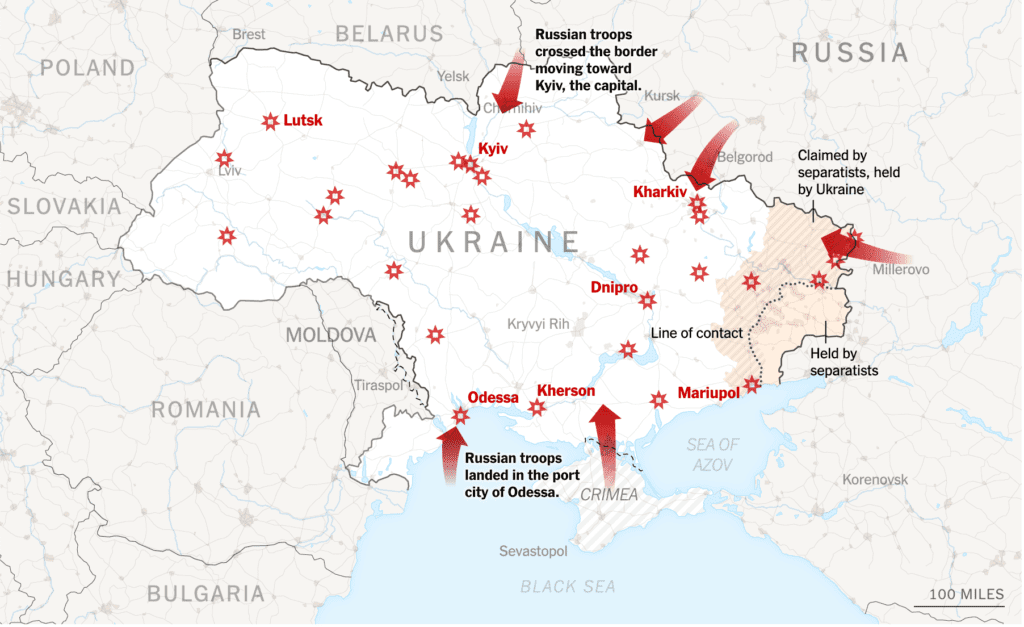
In the early hours of February 24, Russian President Vladimir Putin authorized a full scale Russian invasion of Ukraine. Russian troops entered Ukraine from the north in Kyiv, from the South in Odessa and crossed into the East from Kharkiv. Meanwhile, Ukrainian troops are still fighting Russian-backed separatists on the Eastern border.
Explosions can be heard across the country. According to Ukrainian officials, numerous areas were bombed, including the cities of Dnipro and Kharkiv. Military headquarters and airfields have also been the target of missile attacks. They have stated that ten civilians and more than 40 soldiers have been killed. The number of wounded civilians and soldiers is still unknown. Ukrainian officials have added that 50 Russian soldiers have been killed and six Russian aircrafts have been shot down.
Ukrainian President Volodymyr Zelensky has declared martial law, telling his citizens: “No panic. We are strong. We are ready for everything. We will win over everybody because we are Ukraine.” Footage has emerged showing citizens unable to leave Kyiv, as cars clog the highways.
Word of the invasion reached the United Nations during an emergency Security Council meeting held to dissuade Russia from escalating the situation. The plea of Secretary-General Antonio Guterres to “give peace a chance” fell on deaf ears. According to a European diplomat, an incoming resolution is set to declare Russia’s actions in the Ukraine as a violation of international law, the UN Charter and the Minsk Accords. Ukrainian Ambassador Kyslytsya has called upon member states to do “everything possible to stop the war”.
Source: The New York Times
February 23: After the US implemented sanctions on Russia, the EU followed suit, dealing additional damage. The sanctions package will include the targeting of 351 lawmakers who recognized the Russian separatist regions of Ukraine as independent, as well as 27 individuals and organizations. Although the full list of names targeted by the sanctions has not yet been published, it is already clear that various top Russian officials are subject to this European retaliation. These include Sergey Shoygu (General of the Army), Anton Vaino (Putin’s chief of staff), Igor Osipov (commander-in-chief of the Black Sea fleet) and Sergei Surovikin (commander-in-chief of Russian aerospace forces). So-called Russian “propagandists” are also targeted by EU sanctions, due to their spread of anti-Western sentiments.
February 22: Ukrainian President Volodymyr Zelensky addressed his nation, stating “we don’t owe anything to anyone, and we will not give away anything to anyone”, illustrating his intention to maintain the Ukrainian border as is. Zelensky added that Russian action “may mean a one-sided exit of the Russian Federation out of the Minsk Agreement”. The president also expressed his expectation for international support to continue. To the Ukrainian population, he communicated there was no need for fear or worry, appreciating his country’s calm reaction to the situation.
Germany announced that Russian gas pipeline project Nord Stream 2 will be halted, in response to Russian troops entering separatist regions in Eastern Ukraine. Furthermore, German Chancellor Olaf Scholz accused Putin of having infringed international law and the 2015 Minsk Agreement, which sought to end war in Eastern Ukraine.
Speaking from the White House, US President Joe Biden described the deployment of Russian troops into the separatist regions in Eastern Ukraine as “the beginning of the Russian invasion of Ukraine.” As a response, President Biden announced the implementation of new economic sanctions against Russia that will go “far beyond the steps [the US] implemented in 2014.” These new sanctions will target two large banks in Russia, preventing them from being able to get loans from the West. President Biden explained Russia’s government could therefore “no longer raise money from the West and cannot trade in its new debt on [the US] markets or European markets either”.
February 21: In a press conference addressing the nation, Russian President Vladimir Putin acknowledged the independence of the Russian separatist regions of Donetsk and Luhansk. Subsequently, Putin gave the order to send Russian troops into Eastern Ukraine. Footage surfaced that seemed to show Russian soldiers moving towards the Ukrainian border. An emergency United Nations Security Council meeting was held during the night in response to Putin’s state television speech. The United States and its allies condemned Russia’s actions as a violation of international law, the United Nations Charter, and Ukrainian sovereignty. Meanwhile, Russian Ambassador Vassily Nebenzia continued defending his country’s actions. Mr. Nebenzia stated that the troops sent into Eastern Ukraine – the “peacekeepers” as Putin referred to them – intend to aid Russian-speakers living in Donetsk and Luhansk. According to Mr. Nebenzia, they are victims of the Ukrainian government. The meeting ended without any action taken.
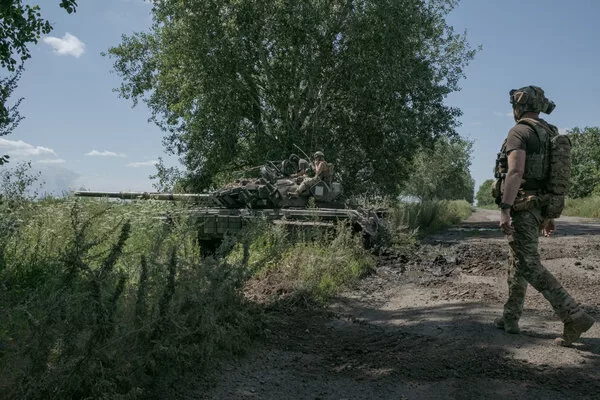
Featured image by: Finbarr O’ Reilly for The New York Times.
It’s true how at some point in our lives we’ve all set goals and good intentions for the year to come, we have these great visions and high expectations of ourselves and how the year is gonna play out. At first it’s only natural to stay motivated, excited, and essentially feel like you’re on top of the world, though little by little it appears we make it down our high mountain of success and in no time go right back to the bottom.
Everyone goes through different cycles. One week you can be the most productive person in the world, someone who has somehow managed to have the perfect work-life balance, gets everything done on time, and is overall on their A game. Next week it’s very possible that working towards your goals may be more difficult. When our motivation decreases, the idea of achieving our goals seems to be further away than originally thought.
So, “How can one stay motivated and most importantly commit to achieving their goals?”. My general answer: Good habit formation. Habits are behaviors which have been repeated several times to the point they become automatic. Staying motivated forever is not realistic, there will be days where it will be incredibly easy to simply go for the option that goes against achieving your goals and the truth is that being motivated despite being great, can only take you so far.
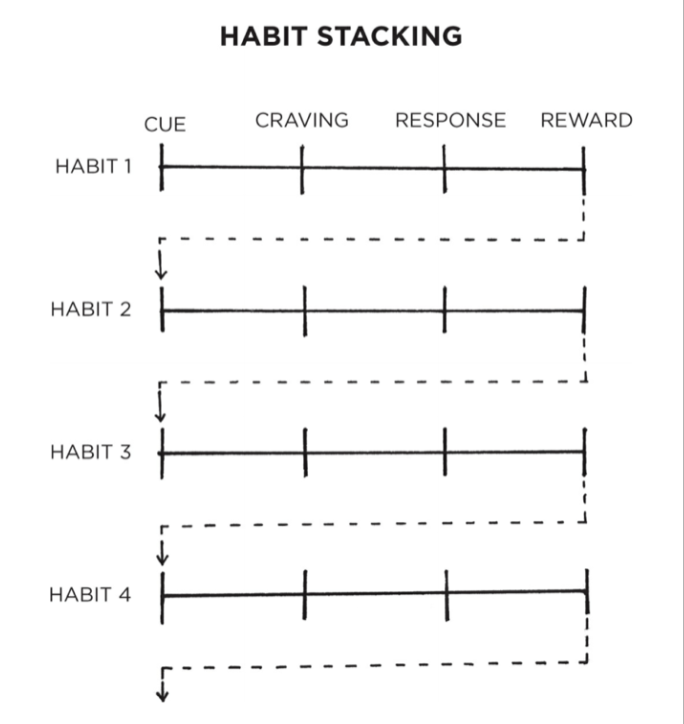
Taking a series of actions everyday whilst being consistent is key to achieving your goals, this is why habit stacking is probably the best way to incorporate new habits into your daily life. The fundamentals of habit stacking are, taking a daily habit you do everyday and pairing it with one you want to adopt. This method was originally created by BJ Fogg in his Tiny Habits program and is very well explained by James Clear in his book, Atomic Habits. This technique works very well because you are already working with behaviors and patterns that you’ve been doing for a long time, which is why it is more likely that you will stick to these new habits.
The basic formula of habit stacking is, After/Before (current habit), I will (new habit).
Every habit is initiated by a cue, this cue then triggers a craving that will generate a response that will lead to a reward. Someone who wants to eliminate a bad habit or incorporate a good habit should be aware of their environment and the cues around them, especially the ones that stand out. This way one can reduce their exposure to negative cues and find a way to make the cues of good habits as obvious as possible.
Craving
As for the craving, the secret is making it attractive or somewhat desirable. A great way to make a craving attractive is by pairing an action you want to do with an action you already have to do. This can range greatly. The formula for this would look as follows:
After (current habit), I will (new habit) After grabbing my phone, I will go on DuolingoAfter (new habit), I will (habit I want) After I go on Duolingo, I will check Instagram
Humans generally follow the law of least effort and the easier something is, the more likely we are to gravitate towards it. Due to this, it is highly recommended that one creates an environment where doing the right thing is as easy as possible and that when creating a new habit one decreases the amount of steps you have to take, in other words make the habit an easy thing to do. Additionally, it’s good to remember how in the beginning stage of adopting a habit, once you execute it, it should take no more than two minutes to do.
Reward
Last but not least we have the reward. Behaviors that are instantly rewarded are more likely to keep occurring just as behaviors that are often punished, are avoided. In order to maintain a habit, one should feel instantly successful after completing it, after all the goal is to increase the odds that said habit or action will be repeated again. This is why starting out small is key. It can be something as simple as, today I will read three pages from a book. It takes no time, no effort, and after reading three pages you will feel instant success. From there, you grow and build on the habit.
Habits are very much underrated. They are actions people perform on the daily that affect their lives in both positive and negative ways. Though developing better habits can be a great way to further advance your goals, adopting only one or two habits are not going to revolutionize your life in short notice. Practicing good daily habits will get you closer to becoming the person you want to be, though because we live in a world that is constantly changing, we have to constantly adapt to our situations and make sure that our current habits align with our values and that they are serving us.
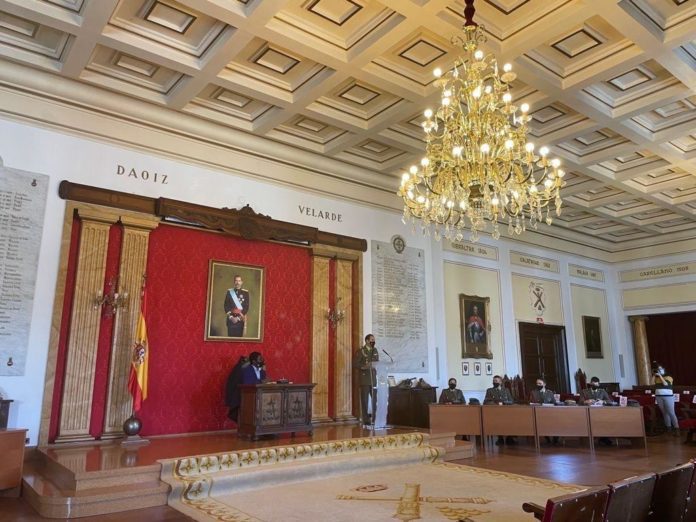
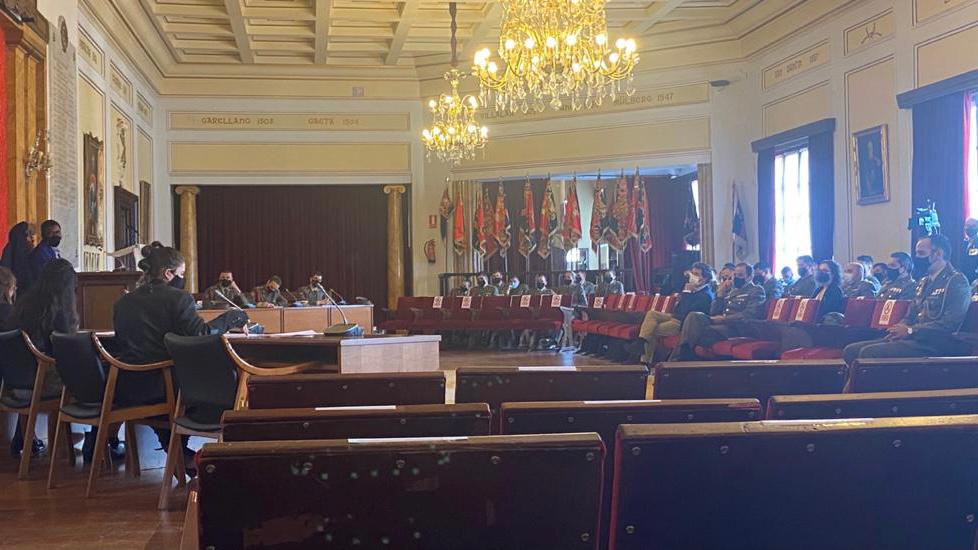
The traditional debate between the Spanish Royal Artillery Academy and the IEU Segovia Debate Club was held last Monday in the great Assembly Hall of the Artillery Academy. Despite the pandemic, the event was able to flow smoothly thanks to the security measures efficiently applied that ensured the safety of all participants.
The prompt of the 4th Royal Artillery Debate was: Should the European Union create a Joint-Military Force? The delegation of the IE Debate Team took the affirmative stance arguing that the EU should indeed create a Joint-Military Force, while the delegation of the Artillery Academy took the opposing stance and argued against it.
The event was introduced by the Director of the Artillery Academy, Col. Alejandro Serrano Martinez, and the Vice-Rector of IE University, Dr. Miguel Larrañaga Zulueta. Mohammed A Foboi, an IE graduate student, held the role of moderator and skillfully directed the whole debate.
Both delegations were given several opportunities to present their position and attempt to weaken the arguments of their opponents under a timeframe of around 2-3 minutes per participation. The debate was divided into different sections to ensure that the political, economic, and social dimensions of the prompt were thoughtfully covered.
The overall argument of the Academy cadets was that having a Joint-Military for the European Union was plainly unnecessary because NATO has a solid structure that has worked quite well for the last 70 years. Moreover, they argued that right now, it is very bad timing to be trying to form such force with the pandemic and the repercussion it provoked on all European countries.
On the other hand, the IE Debate Team was more focused on the fact that the European Union’s threats do not always align with the threats NATO has. A great part of their argument was based on this, and thus they claimed that creating a Joint-Military was evidently worth the effort. “What happens the United States goes against the European Union?” declared one of the delegates, “America will always put America first.”
More interesting points and arguments were made throughout the debate by both teams during the period of the closed discussion. After this time ended, the public was also given a chance to participate in this engaging debate. Different members of the audience, including the Colonel and the IEU Vice-Rector, presented their points of view and offered challenging questions to both teams, which further enriched the discussion.
Once this space was concluded, time was given once again for both delegations to present their final points and finally close the debate. The participation of the IEU students and the Academy cadets proved to be of great interest for all those who came to watch this lively discussion. Evidently, they had done a great job preparing themselves for this event and were able to exceed all expectations.
Being able to carry out such engaging debate is something quite gratifying and worthy of admiration. Congratulations to all the brave participants and a special thanks to the organizers of this event as well as to all those who were able to join us on this very special afternoon. Without a doubt, this wonderful tradition between both renowned institutions must perdure. After all, debating is very beneficial for the educational development of all students.
I highly encourage those who are curious and always enjoy a good debate to join us the next time!
Hello Everyone and Welcome Back to Spring in Segovia!
It’s finally Spring Break!!! I hope you all have plans and will enjoy your well-deserved holiday after midterms. If you read last week’s article (click the link if you didn’t) you would know that recently I undertook a self care challenge to help myself destress and rejuvenate for the holidays! Yesterday was the last day of my challenge and I can truly say that I enjoyed the experience. Here’s the lowdown of what exactly happened this week and why you should try this challenge too!
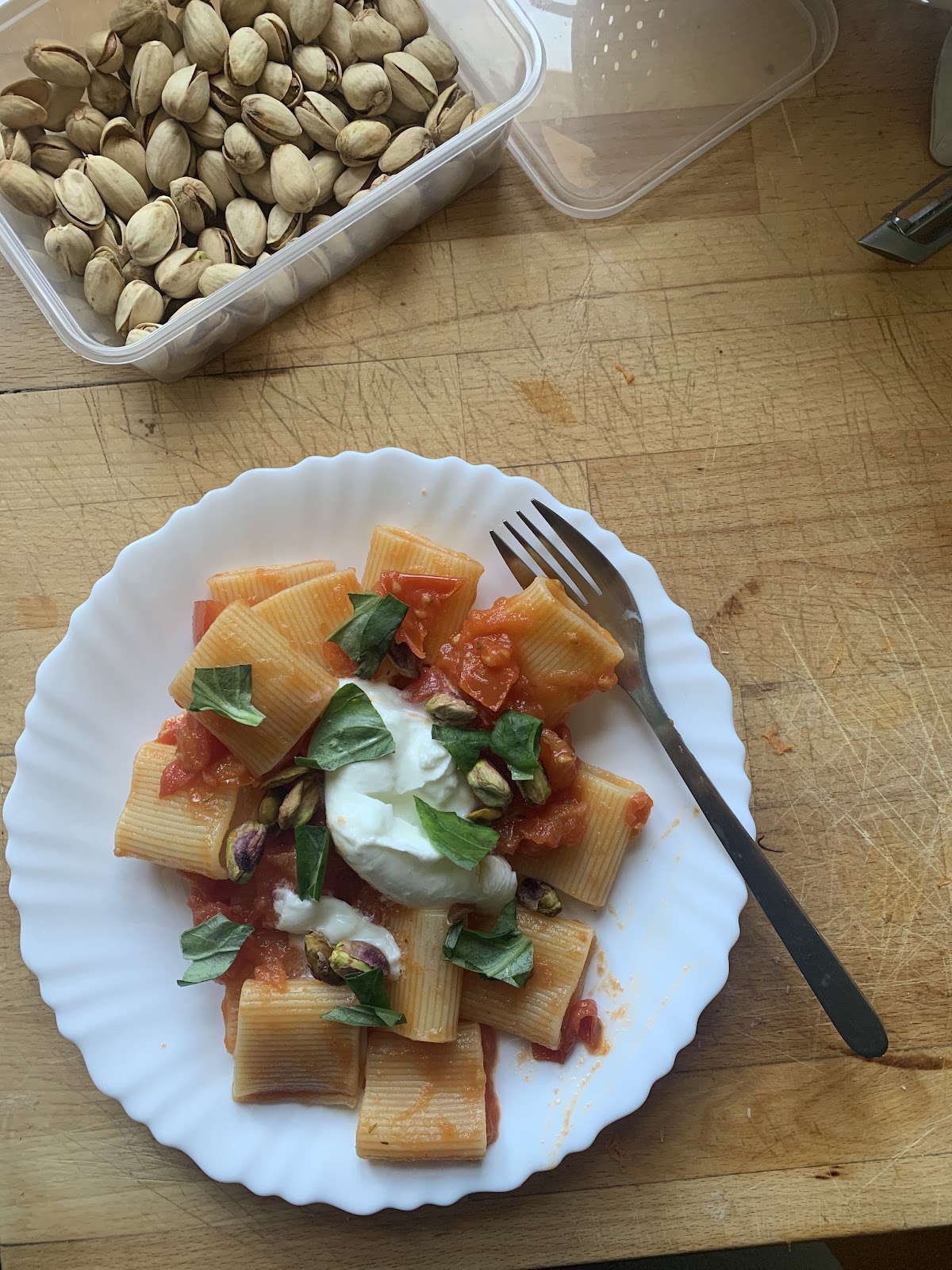
The other day I went to the big Carrefour to stock up on Italian products, so I was very happy to use my creativity to combine them and recreate the recipes I’ve seen on the internet! So this is the result! I really felt like a chef!
Day 2 – Take a Hot Bath/Shower
Illustration by Vlada Rubanenko
One thing I am very grateful for, is making me discover warm baths again. Since then, it has become a ritual for me to just chill in my bathtub with an incredible amount of foam and just relax watching a tv show or reading a book. I know it sounds like something that people only do in tv shows but I swear it’s true!
Day 3 – Take a Walk in Nature
Illustration by Felic Art
When I think about moving to Madrid next year I always think about how much I will miss having so much nature around me as we have here in Sego. And even though some people say that after the first 3 months of first year there’s nothing more to see here I believe this is not true! In fact, whenever I exercise I discover new paths and little roads that lead to beautiful hidden panoramas. Go explore Sego as much as you can while you’re still here!
Day 4 – Reconnect with Friends
Illustration by Felic Art
I have to admit I am a very bad texter, and therefore I get further from my friends that are far away quite quickly. Especially, I haven’t talked with the friends I met during my exchange in Australia in a while! So I used the occasion this challenge offered me to contact some of them again and know what’s going on in their lives! It was so nice to know their updates and how much their life (and mine also) has changed since we met 3 years ago. I will surely plan a trip back to Australia as soon as borders will be open again.
Day 5 – Unplug From Social Media
Illustration by Suat
I don’t really consider myself addicted to social media, but today I disconnected the notifications from all of them (except whatsapp, otherwise my mom would have probably flown here in 2 hours to kill me because I haven’t replied to her in 2 minutes time). And it honestly really helped me not checking Instagram and a lot! Lately I feel like everyone has been more connected than ever and this is surely not a positive thing, so I’ll try to keep my Instagram notifications off for as long as I can.
Day 6 – Sweat It Out
Illustration by Andrii Bezvershenko
Ok, here I must be honest, this day happened to be the first sunny and warm day after a while, so, no matter how much I wanted to go and exercise around Segovia, I guess the drinks in plaza were stronger than my will!
So I was kind of forced to wear a nice skirt, go to the plaza and enjoy the sun for the whole afternoon, what a pain! Please take a moment of silence to think about my sacrifice.
Day 7 – Pamper Yourself
Illustration by Katie Daugherty
Since I moved to Segovia I have always been going to the same beautician that always remember me all the treatments she offers (face cleaning, manicure and pedicure and whatever else you can think of), and I always replied to her that I would have tried sooner or later but never actually found the time. This week I finally tried and it was amazing! Also, additionally to the treatments I got around 2 hours of free spanish class as the estheticians only speak spanish! I highly recommend you to try!
If you want to try them too here’s her information, I highly recommend it for everything beauty related (especially laser treatments!).
I am not really a huge dancer, especially because when I moved here I realised how embarrassing my dancing skills are compared to South American and Spanish people. But it is still fun to enjoy a night with friends having a couple of drinks and then dancing all together, so that’s what we did. Also, I’ve been asking my South American friends to teach me how to dance, so I am happy to say that I am slowly improving!
Day 9 – Declutter
Illustration by Mila Spasova
This is actually what I needed the most! Everyone who knows me well is aware of the fact that I am EXTREMELY messy! And the closer exams get, the more excuses I make to avoid tidying up my room. Because of this, I won’t put a picture of how my room was before I organised it because you would get scared. I started by picking up all the clothes that were distributed around the room and dividing them into a pile of things to wash, one to iron and one to just fold back. Then I started ironing what needed to be and I made my bed (I get THIS lazy!). I was so proud of myself that I asked my roommates to come and see my amazing work! Now I feel so much better, let’s just see how many days it will last (probably one).
Day 10 – Try Something New
Illustration by Ashleigh Green
Everyone right now is saying that since the pandemic started it is very complicated to try new things and that there’s a lack of possibilities. Although, I believe this is not completely true; you might not be able to experience all the clubs in Spain, but with a bit of imagination and creativity you can still find plenty of new things to do! For example, the other day talking with my roommate I discovered she found a way to get on the roof of our house and enjoy the sunset having a wonderful view of Segovia! So, yesterday, even though I’m SUPER scared of heights, I went. It took me around 30 minutes to get up there, and we nearly missed the sunset because of me, but I made it! Once I was there, the view was breathtaking! We brought a speaker and two beers and just enjoyed the moment until the sky became dark and we had to go back. This was definitely the best day of the challenge!
I hope you guys enjoyed this challenge because I certainly did! I really think that it is worth trying out as by the end of the week I felt very accomplished and relaxed. I really like pushing myself to do these challenges as I probably wouldn’t have such a healthy lifestyle in my everyday life! Also, I believe it is really important to give ourselves more self care time in these stressful times.
If you decide to try this challenge out for yourself (which I really hope you do) Don’t forget to share your experience with us @ieustork! And don’t forget to let me know if there’s any challenge you would like me to try!
Unfortunately, it’s that time of the year again when students spend countless hours cramming as much information they can, whilst simultaneously balancing their multiple projects, essays, case studies and additional homework (cuz why not?).
Exam season has always been one of the most stressful times for many students and after this incredibly difficult year, finding time for yourself in order to search for inner peace should be a priority!
I’m someone who is so easily stressed; it comes to the point where I can no longer be productive. In my research on how to achieve inner peace and simply deal with stressful situations, I came across a company called MindValley.
MindValley is a company founded by Vishen Lakhiani that offers multiple programs and courses that challenge you as a person and guide you to a better self. In times where everyone is doing their best to social distance and spend more time inside, what more productive way to spend your time than taking an online master class!
My favorite master class that I attended was one directed by a behavioural scientist, self-help book author, TV and radio broadcaster, and hypnotist, Paul McKenna.
In this master class, I learned how to reduce my stress when I feel overwhelmed, reduce my fear and anxiety (which was a huge bonus for me), develop positive energy, and improve my overall physical and mental health.
I learned in his class that there are the three stress myths that people tend to believe:
This is not true at all! In fact finding time for you to relax and take time for yourself has proven to better increase your creativity, productivity, and problem solving skills! So next time you think that if you’re not stressing enough you will never achieve any of your tasks, think about Paul McKenna saying, “Not taking care of your wellbeing is a false economy.”
This was my favorite myth because it came with a great suggestion. In the class they talk about working smart and how instead of simply cramming everything for multiple hours, you should be working in sprints. Take 50 minutes to study or work and then have a 20 minute break, it gives you room to breath, get the juices flowing, and will give you a better workflow.
I admit that I am the first in line to believe this. I hate stress, I hate how it makes me feel, and I wish it would go away. However, moderate stress can be good. It keeps you intact with the tasks that you need to get done. If we were all super care-free, we wouldn’t care about failing all of our exams and flunking out of university. In the end, it’s all about finding balance in your life.
Now after understanding the myths of stress, I can finally reveal this new relaxing method I have incorporated into my life. The Havening Technique from Paul McKenna has significantly helped me remain more calm and find inner peace in times of stress. This technique has been used in the military to help soldiers deal with PTSD and trauma.
The Havening Technique
How it works is that you begin by closing your eyes and thinking of something that upsets you. It can be anything, whether related to academics or personal issues. This is a psychosensory technique as it involves eye movement and tapping on various parts of the body. By moving your eyes you are desensitizing. Moving your eyes in a vertical manner will create alpha waves whilst lateral eye movements create delta waves. Our goal is to create delta waves.
After thinking about that upsetting memory you are going to put your hands on opposite shoulders and begin stroking your arms gently whilst clearing your mind.
Once you’ve done that you will think of a pleasant activity. It can be anything from walking on the beach to playing with your pet or spending time doing your favorite hobby. Once you’ve thought about your happy place, begin moving your hands on your shoulders down and up whilst counting to 20. As you are doing this move your eyes across, going from one side to the other.
Repeat this process of counting to 20 with three different scenes. Move your eyes laterally left to right about 20 times. This technique should take you no more than 15 minutes. It is an easy way to simply take a step back from all the stress and anxiety you are dealing with and finding a way to calm down. This technique can be done mostly anywhere although it is suggested that you are not driving when doing this as you are closing your eyes and entering in a deep state of relaxation.
Here is a video taking you through each step of the process:
I’ve been practicing this technique for a few weeks now and I feel much more calm and at peace with myself when I perform this technique. Hopefully this will work for you as well and will help you in the long run!
Let us know in the comments below if this technique has helped you out!
Hello and welcome to Spring in Segovia; the perfect guide on how to enjoy the most beautiful season of the year in the quaint town we call home!
With all the problems COVID has caused in this past year, the economic crisis is one of the problems that hit Spain the hardest. Therefore, we can all try to do something to help our beloved Segovia and its small businesses that are all around us.
So here is a short list of shops able to suit your every need!
Food Products
Here’s some alternatives to shop in carrefour and dia!
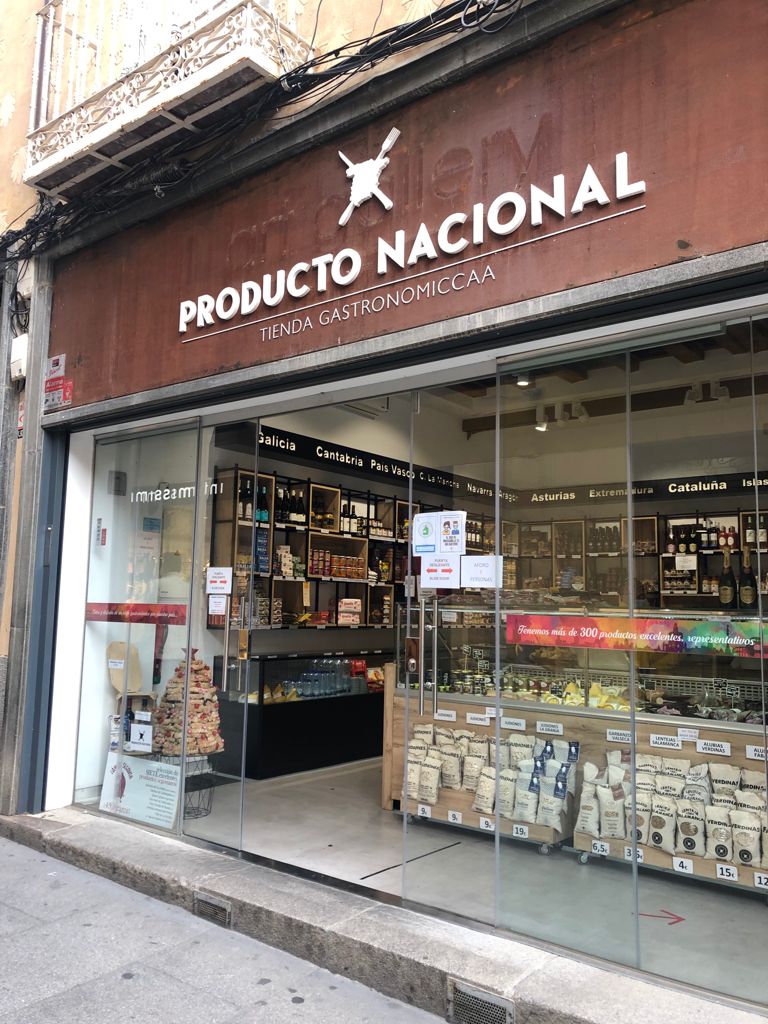
Producto National
There are many shops like this in Segovia, where all the products are from Spain and are divided by region. You’ll be able to find good wines, cheese and typical Spanish products of very good quality. Also, the staff speaks english and they are always ready to help and give you the best advice depending on your tastes. Enjoy the 5% discount all IE students have!
Probably most of you know this place, as is the best place to buy good wine and alcohol. Although, what not everyone knows is that you can find many other products such as cheese, chocolate, olive oil and even skin and hair care products! They are also going to serve you coffee if you want!
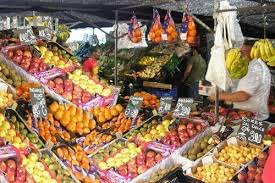
Everyone must have seen the farmer’s market that takes place in Plaza every Thursday morning (10am to 1pm), although I know many people who still have never gone there to buy something. The reason why I believe it is great to shop there is because the quality of the fruits and vegetables is way higher than in any supermarket, the price is cheaper and the people working there are nicer.
Little Fruits and Vegetable Shop
This little stall around the corner of plaza, just on your way to irish (a way that you all know pretty well), somehow has EVERY type of vegetable, herbes, fruits and vegetable related product you can imagine, all in the 2 square meters. Also, the people working there are super nice and will only give you good quality products. Once, I had asked for some mint and the worker showed it to me and said that it didn’t match their standards of quality, therefore he wasn’t going to sell it.
Here’s a super good store with super good healthy and gluten free and organic products. If you are allergic to gluten, vegan, or just want to eat less processed food this is the place for you!
Welcome to the paradise for architecture, design students and everyone that (like me) is obsessed with stationary and art supplies! And IE students get a 10% discount 😉
If you are looking for a nice gift for a girl, I believe this is the place! Here you can find good quality handmade jewelry. The staff is super nice and ready to help you for every specific desire. Also, they remember their customers even after a long time they’ve been in the shop.
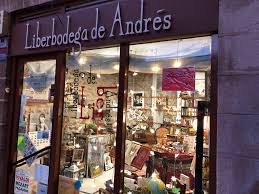
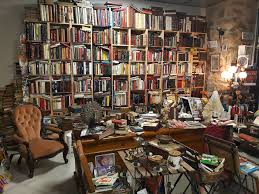
This is an antique store that has old books and things about segovia. It’s perfect if you want to buy something unique for your house or to take home. And also cool art pieces 🙂
This is a unique boutique that has cute clothes and jewelry in beautiful colors and styles! The shop always has new items whenever you go as it is a great alternative to Mango and Berska as they also have a lot of basic pieces perfect for any outfit.
Let us know if you have any other recommendations in the comments below or tag us on Instagram @ieustork!
As you may have noticed, winter is coming to an end, and so is this section of Lifestyle Segovia. As days are getting longer and warmer, curfew is being extended, and Juan Bravo is finally opening again, we are about to welcome Spring! To give this incredible season the warm welcome it deserves we will be starting a new section called Spring in Segovia. Stay tuned for the next article so that you don’t miss out!
For this season finale, we wanted to give you some tips to help you through these last few winter weeks! Each tip corresponds to a different aspect of life; all of which we have touched in our series 🙂
Mental Health Tip
Illustration Courtesy of Asleigh Green
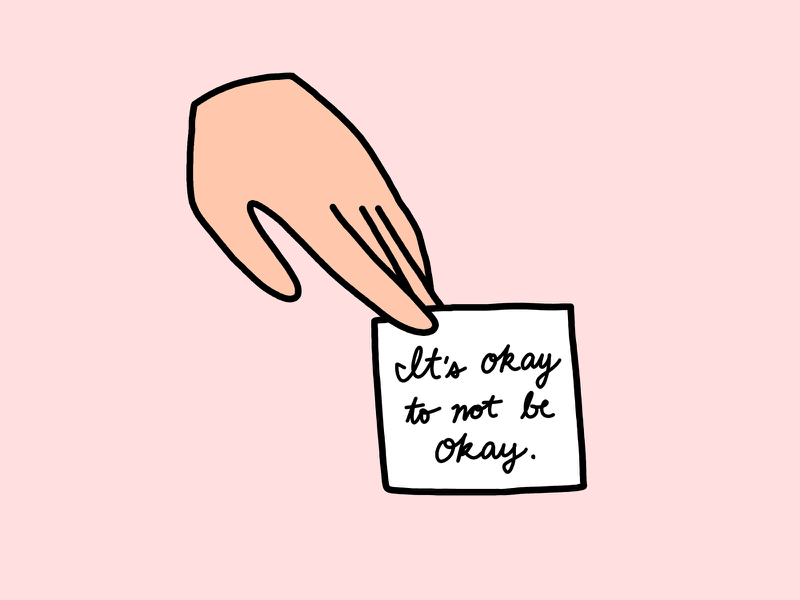
We’re starting off with something that has probably touched most of us personally in the last period of time. With all the restrictions going on and changing very often, most people have been feeling more overwhelmed, anxious or sad since the pandemic started nearly a year ago. First of all, we should all recognise that we’ve been living a very hard time, that none of us have ever experienced in our lifetime and for this reason we should allow ourselves to not be ok sometimes, as says the famous quote “it is ok not to be ok”.
Although, as we have survived the last year, I am sure we will keep on going and that things will get better. Therefore, we shouldn’t sit and let life happen to us. Instead, we should try to do some things that make us feel better. On sad days, we could try to take a break from screens and our tech-poisoned daily life (yes, I know it is very hard, but make an effort!) and surround ourselves by nature. Us Segovian students are very lucky, as we have plenty of green areas to go explore, have a walk or do yoga, while admiring the wonderful scenarios of Castilla y León.
Finally, surround yourself with the people you love, and try avoiding negative people. In fact, if you are going through a hard time, receiving an extra load of negativity might increase your anxiety, and definitely won’t help you.
If you want some more mental health tips take a look at our previous articles:
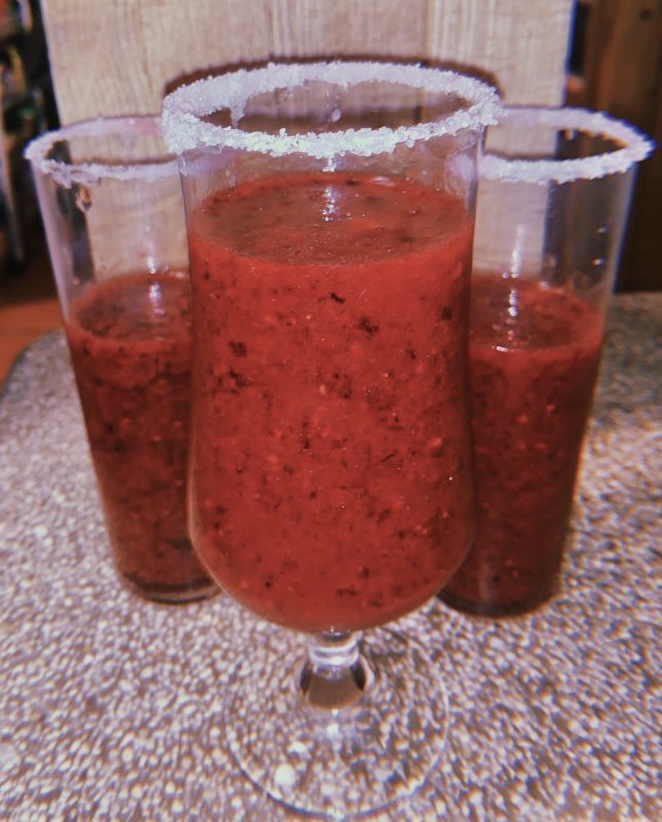
Now, talking about happier topics: have you ever tried to make homemade cocktails with your friends? If not, you should, as with the restrictions changing so often being your own bartender is a good skill to have 😉
Here’s an easy recipe to start off with some easy to find ingredients (so easy that you’ll retrieve them also in Segovia).
Ingredients for two servings:
3 shots of tequila
One shot of Triple Sec (which you can omit if you can’t find)
Juice of two limes
100 grams of frozen fruit of your choice
Procedure:
First of all, wipe the rim of the fanciest glass you have in the house with a lime and then cover it with a bit of salt.
Then just put all the ingredients in a blender and mix everything for 20-30 seconds, until you get a nice slushy consistency.
Voilá, your cocktail is ready in only two minutes!
Disclaimer: if you don’t use a fancy glass, you won’t get the same effect
Sustainable Tip:
Image Courtesy of Martyna Szczegielniak
I believe that doing our part to protect the environment is really important, even if only with a little thing. We all know that eliminating plastic from our lives is close to impossible, and even giving up coffee capsules, Q-tips and all the other very polluting items that we are really used to having in our everyday life. Although, one thing we could do is to try buying our clothes in a more responsible way. For example, instead of buying ten items from Zara or any other fast fashion chain, we could buy less items from a sustainable brand or from a vintage shop. Many companies are now trying to create their clothes out of recycled materials and limiting the waste of water such as the brand La Semaine Paris. Also, many brands are trying to be socially responsible, using part of their profits to give free clothes and healthcare to less advantaged people, such as Toms. Finally, buying vintage is now very popular, and, especially in Madrid, you can find many vintage shops where you can buy amazing luxury clothes in perfect conditions for a very good price. Finally, try to support small businesses around you in your everyday purchases rather than the big brands!
If you want some more sustainable tips take a look at our previous articles:
Of course we wouldn’t forget to include a recipe, especially as us students often have trouble finding ideas and end up eating the same thing every week.
Since the “new way” of making burritos has become viral on Instagram, I just can’t stop eating them! It is a super quick and easy way to prepare a tasty meal, especially if you have friends over and you don’t want to spend hours in the kitchen. Also, I love the fact that you can personalise it choosing the ingredients you like the most.
Ingredients
*fully customisable*
humus/guacamole or any other spread
Black beans
Corn
Chili
Cheese
Mexican tortillas
Procedure:
Image Courtesy of @veggie_nerd
Spread the sauce you want on the tortillas, then cut one side from the centre to the out. Now, just imagine the burrito to be divided into four triangles, and fill each one with one ingredient you like. Finally just flip each quarter of the tortilla so that it turns into a single triangle.
Personal tip: I also like to toast it for a few seconds to make the cheese melt and the tortilla crunchier.
Image Courtesy of @veggie_nerd
The pictures are courtesy of the blogger who made this new method famous on tiktok (@veggie_nerd on instagram)
Self-Care Tip
Illustration Courtesy of Katie Daugherty
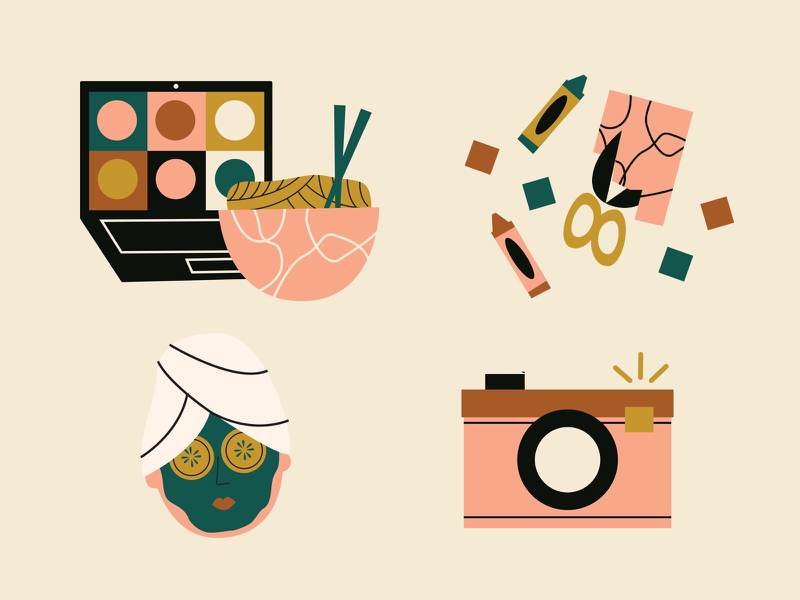
Finally, there’s nothing better than relaxing and taking some time for yourself after a long day. This might be very obvious but every Sunday night, after the weekend, I like to take a long warm bath with bubbles, put a face mask on and just watch a few episodes of a tv series while chilling. So, I encourage you to take one moment every week to pamper yourself with your favourite beauty routine; you’ll see how it has an incredible impact on your mood!
Outdoor Adventure
Image Courtesy of Lisa McCormick
As Segovia has rounded the corner of January into February, so has the weather. The gloom of January’s low temperatures and dark grey clouds has finally seem to have parted, making way for comfortable, sunny, sweater-weather conditions of February. Mother nature is teasing us with a glorious spring. And with a new season comes a new variety of ways to enjoy the outdoors in Segovia.
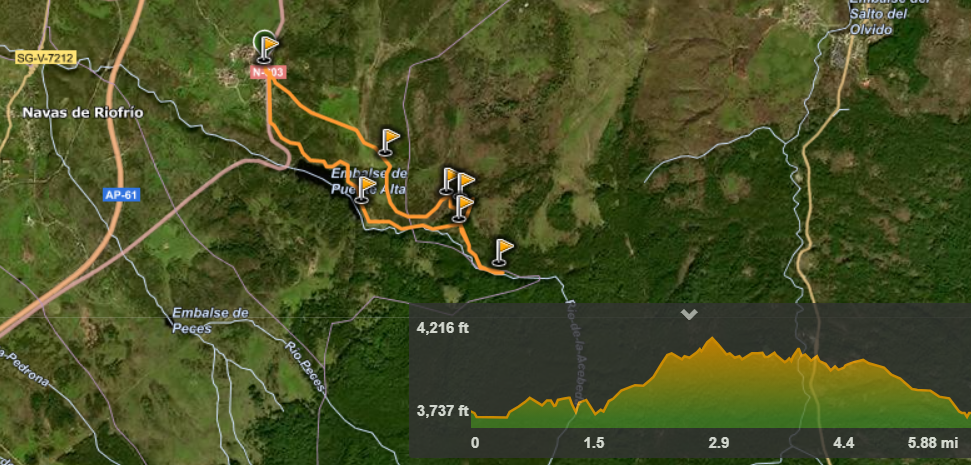
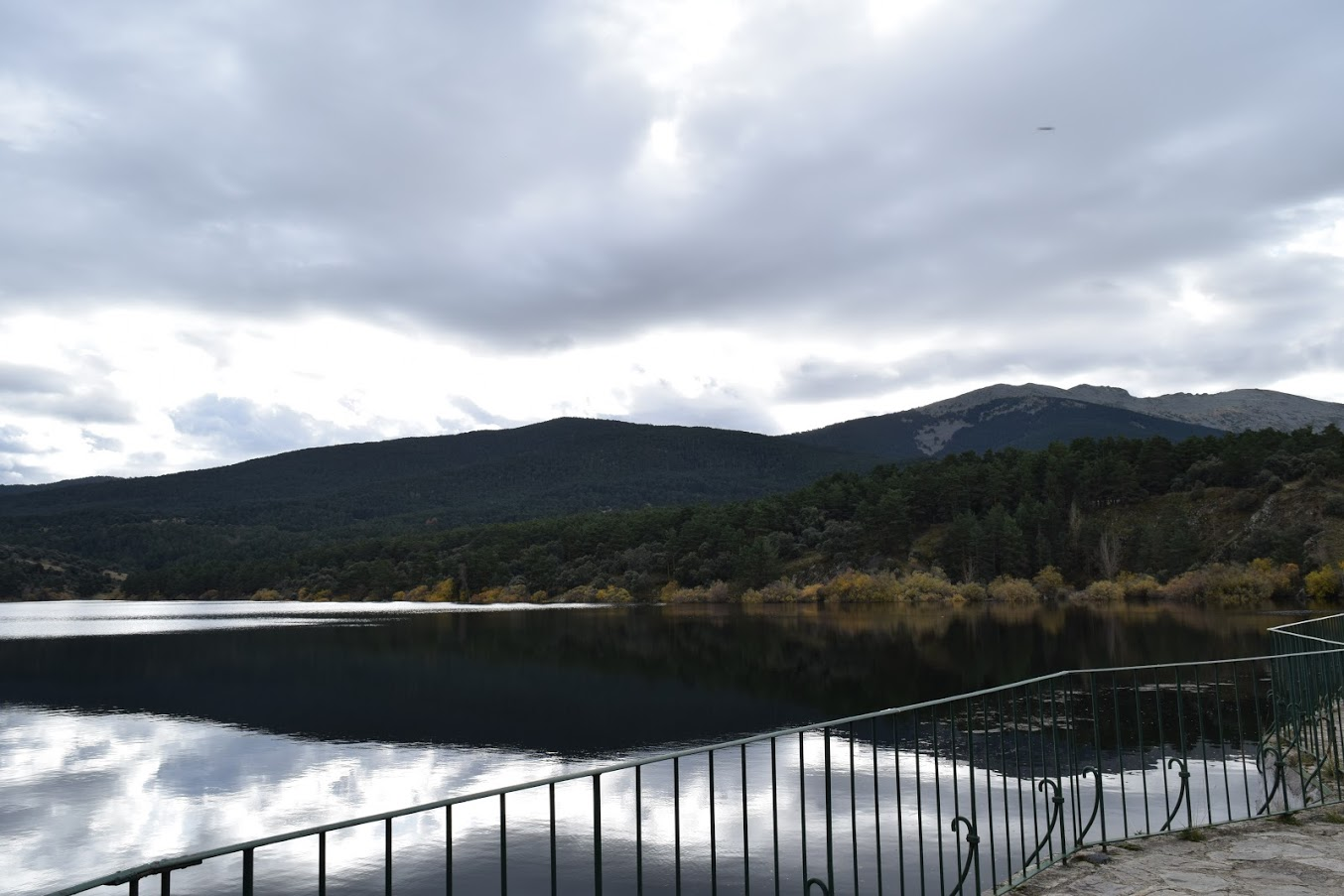
The month of February probably stands as one of my favorite months to get outdoors in Segovia. She really offers everything during this changing season – snow-capped mountains and roaring rivers contrast with the warming weather and newly-green flora. To enjoy this combination of seasons, I’m going to show you a hike in Revenga, along the Rio Frio valley to the foundations of the Segovia aqueduct.
We’ll start out by taking the bus to Revenga, a cozy little town at the foot of the Mujer Muerta. Next to her runs the Rio Frio (Cold River), which originates on the southern face of the Mujer Muerta and runs until joining the Rio Eresma near Segovia. In the 1950s, Spain dammed this river to create the Embalse de Puente Alta (also known as the Embalse de Revenga), a cute little reservoir nestled in a forested valley.
After exiting the bus, cross the highway and head south along the side road as it turns left and heads towards the reservoir. When you reach the reservoir, you can walk out across the dam and see the view across the pond up into the Sierra de Guadarrama. Every time this view is different; sometimes clouds cover the tops of the mountains, sometimes you can see a dramatic snow-capped peak, and sometimes the bare grey stone of the mountain remains exposed. After marvelling at this sight, continue the journey down this road until you reach the end. Along the way, you’ll encounter a Spanish Civil War era bunker, a remnant of the battle of Segovia.
When you reach the end of the paved road, you’ll take a left up through the gate along the path. Here, we enter the Sierra de Guadarrama National Park, the protected area running along the border between Segovia and Madrid. Follow this trail for a couple kilometers until you intersect with another path, onto which you will turn right.
Go down this new path until you reach the Azud del Acueducto (pictured above). These foundations are a rebuilt replica of the original foundations of the Roman aqueduct which runs through the heart of Segovia. This valley served as a passageway between Madrid and Segovia during the Roman era, and the aqueduct followed this path. Many of the stones you walk on during this hike were walked on by people 2,000 years ago. It’s certainly something that puts you in perspective.
Once you enjoy the scenery of the Azud del Acueducto, you can turn back around and head downriver the way we came up. At the intersection, keep straight. Going back to Revenga, we’ll take the ridge over to get a view of the lake. This is best seen at or around sunset, when the colors are vibrant and you can see the sun setting over the lake. Eventually, the path will merge with a gravel road, and you can take this road all the way back to Revenga.
To do this hike, make sure to bring sturdy shoes or boots. While it has been sunny lately, there’s still leftover mud from January, and in the next couple of days rain and snow may come back. Overall, however, this hike is a great and accessible way to spend an evening getting to know the Segovian countryside much better! I hope you enjoy, and I’ll see y’all in spring!
-Justin Morgan, our resident hiking expert
Stay tuned for our new edition “Spring in Segovia” and share your personal tips with us on @ieustork !
MADRID — In the late afternoon on the 23th of January, IE Student Alejandro Erco Gamarra spotted a large gathering of people holding signs and chanting at Jardines del Descubrimiento right off of Calle de Goya. Gamarra abandoned his car to head for the protest to further investigate. Signs read, in English translation, “Spain, wake up!” and “Fake Pandemic.” Almost everyone was unmasked, not socially distanced, in protest against Covid-19 restriction and mask mandates. We later joined Gamarra to interview protesters and cover the scene.
The protest seems to be in response to the recent tightened restrictions in Madrid, and Spain at large. In wake of the increased cases of Covid-19, the Community of Madrid has implemented new restrictions in order to mitigate the spread of the virus and minimize deaths. On Monday, January 25 new curfews will be pushed to 10pm and all businesses must be closed by 9pm. These regulations came as cases climb, but deaths remain more or less steady.
Protestors gathered for various reasons related to the restrictions. Some cited fears of a worsening economy and at-risk businesses, others claim violations of constitutional rights, and some do not believe in a pandemic at all. The protest shows an increased politicization of Covid-19 in Spain and Europe, as well as backlash against increased regulation due to the pandemic.
In between the music and speeches, the team managed to interview several of the protesters. Ranging in casual onlookers, anti-maskers, police representatives, organizers, and even the Seres Humanos Galacticos (Galactic Human Beings). The protest remained peaceful throughout the evening.
A group of four protestors, self proclaimed representatives of El Pueblo por la Verdad, Units per la Veritat, Denuncia Colectiva de Cataluna, and Soberania y Salud drove in car, on buses, and other means from Catalonia in order to appear at the protest. It appears that several of the attendants had travelled in order to meet at the capital. All four spoke out against the international handling of the pandemic, citing common conspiratorial arguments that are circulating in the internet.
Speaking to one protester, they claimed that the pandemic was fake and that they want to see Covid-19 restrictions lifted. The same protester added that he wished to see a version of former US President Donald Trump come to power in Spain. A nearby protester was draped with the American flag, chanting “make America great again!” Their exclamations were said with a particular nonchalance yet enthusiasm.
A nearby woman carried a sign saying “medicos sicarios,” suggesting that doctors and nurses are deliberately killing Covid patients. She told us that Elon Musk will use the vaccine to implant “nanochips” into the mass population in order to control our brains. Other protestors told our reporters that lying to people about the virus and allowing lockdowns is deliberate murder.
Sonia Bescobachi, the representative of Policia por la Libertad, a group of police officers who are against lockdown measures and mask mandates, was also present. She expressed frustration with what she called a “dictatorship” in Spain that has “taken away people’s freedoms.” When asked how she and her organization of police officers got involved supporting the protest, she vaguely explained that she was “contacted by phone.”
Written by Wesley Swan and Francia Morales. Contributions by Alejandro Erco Gamarra.
Here we are, vaccines have been approved and trials have been promising. Now the stake is at distribution. Most westerners have been hearing of the AstraZeneca-Oxford vaccine, the BioNTech-Pfizer’s and the Moderna’s. But that’s not it, two other vaccines are Russian (Sputnik and EpiVacCorona), another one is Chinese (CanSinoBIO from SinoPharm). And right now there are 64 vaccine candidates at the WHO still undergoing clinical trials.
The interesting fact is who gets what. In our interconnected world, where liberalism is argued to be the end of history, division among states on getting the vaccines is still an important feature. The poorest countries don’t have the priority, and if they do have the chance to get a vaccine, they don’t really have the choice of which one. This, of course, profits to regional powers, seeking influence, still trying to balance the West. The European Union has not only ordered the BioNTech-Pfizer and the Moderna’s vaccine, they have ordered millions of doses from vaccines still on trials, all from American or European firms. It looks a lot like Europe won’t get a non-western vaccine. If we look at other countries, the details of their order become more interesting. Pakistan’s government just approved the Sputnik vaccine, and they were offered a chinese goodwill of 500,000 doses by Chinese government-owned SinoPharm. They also ordered AstraZeneca’s vaccine in case of emergency. Pakistan seems to be in a hurry, with a population of 220 million and a need of 70% vaccinated people for herd immunity. On a map, Pakistan is a buffer state in Asia, bordering the Middle-East. If other Asian countries follow the same path, the Russian and Chinese sphere of influence could be composed of the entire Asian continent. This seems like a good example of the Geographical Pivot of History’s theory, once argued by Mackinder. In this way, if all eurasian countries get one of the two russian vaccines, Russia could reach an equilibrium in the balance of power, where considered as a counter-balance of Western hegemony. China has also its role to play, in South-East Asia, where it could confirm its role of regional hegemon, not only in dominating trade and exchanges, but in dominating health issues, thus political outcomes. The West would be contained, China at their left and Eurasia at their right.
In the Middle-East, the only country that has exclusively been ordering American vaccines is a non-arab state, Israel, the most efficient country for administering vaccine doses with more than 30% of its population vaccinated. Other countries act differently. The UAE has just accepted the wide distribution of the SinoPharm vaccine; Egypt ordered 25 million doses of the Sputnik vaccine; Iran is working on its own vaccine but still ordered around 20 million doses of the Russian vaccine; Syria announced their will to order the Russian vaccine. The Saudi allies, Bahrein, Jordan, Oman are the only countries that ordered one of the US vaccines. Turkey has ordered both the American and the Chinese vaccine.
Monroe’s doctrine would suggest that Latin American countries will be constrained or encouraged to order either Pfizer’s or Moderna’s but Argentina’s choice of Sputnik vaccine seems to balance the choice of Mexico, Chile and Costa Rica.
Latin America and Africa’s choices will probably determine the balance of power for the next decade as the race to vaccine distribution will decide the big economic losers and winners of the pandemic. If China and Russia manage to maintain their role in vaccine distribution while expanding their sphere of influence, the pandemic wouldn’t only be a game-changer for the global economy, but for the world’s balance of power.
Discussing Ukraine’s current position and its will to develop and become a major political and economic power in central Europe is an immense and complicated topic. Historically, Ukraine was part of the USSR and has had close direct talks with Moscow ever since it gained its independence. The desire of Ukraine to join the EU and its lack of recent Russian influence has been seen by many as a loss of Russian international prestige. The Ukrainian population first showed its interest to join the EU in the 2004 Orange revolution, a protest against Russian associated Viktor Yanukovych’s tampered victory in the presidency against Viktor Yushchenko. Since then the Ukrainian population demands advancement and has expressed its will to join the European Union. The 2013 Euro Maidan was the population’s uprising against the president at the time, Viktor Yanukovych, who refused to sign the associating agreement with Europe and rather decided to side with Russia. This betrayal marked the start of Ukraine’s EU era. Ukraine has since restructured with the hope to prosper within the EU. I will argue that Ukraine’s efforts are not the problem in its quest to prosperity but rather it is their historic dependency on Russia that helps this veto power to bully them and moderate this country’s development.
As per the EU Ambassador to Ukraine, Matti Maasikas, the populace is pro-EU by 65%, unmistakably representing its vision. However, historically Ukrainians and Russians share familial ties that go back centuries. Kyiv (Ukraine’s capital) is often referred to as “the mother of Russian cities”. Christianity was introduced via Kyiv in the 8th century, and served as the anchor for Kievan Rus, the mother of modern-day Russians, Ukrainians, and Belarusians, illustrating the historical relations of the two nations.
Putin’s invasions of the Donbas and Crimea have allowed him to slow Ukraine’s development by partially dividing the population and monopolizing its resources. The undeclared war waged by Putin has slowed Ukraine’s integration with Europe. Moreover, Putin has continued efforts to convince the Ukrainian population that joining the EU is the wrong decision, its immense power over Ukraine comes from the fact that they are the country’s main trade partner. Lately, Putin started blockades against imports and exports of goods into Russia further enclosing Ukraine’s economy. And, let’s not forget when Ukraine received preferential Russian gas prices, but this stopped back in 2010, and for a long time Russia had been using gas prices to manipulate the Ukrainian government as Russia was its main gas supplier. Ukraine’s ability to prosper is directly correlated to its economic strength, which is being tampered by Putin. These are all examples of the influence Russia exerts over Ukraine.
Ukraine has clearly stated that it wants to be a member of the EU and NATO as soon as possible and that they will do all it takes to succeed quickly. However, the EU expressed that they will not receive a request from Ukraine to become a member state in the short term, but the EU agrees that this could be possible in the long term. As said by president Zelensky, “It seems to me that we just need to make a country that Europe really wants.” And this refers to having integrity and economic strength. As said by the EU ambassador, “The biggest problem is the fight against corruption in the judicial system and reaching EU environmental standards” followed by his phrase, “they must build political, economic and humane connections to the EU”. Ukraine is currently the poorest country in Europe according to the international monetary fund. In 2018 Ukraine had a GDP of €2,963 which is 8% less than Moldova. Additionally, Ukraine must redo its judiciary system. Both Supreme Court judges and general prosecutors must be verified as honest individuals. Corruption must be combated before any prosperity can be reached. Ukraine must also reach international environmental standards which are extremely costly and must be met to join the EU
Eventually, Ukraine signed the Association Agreement (AA) with the EU in 2014. Historically, Russia was Ukraine’s biggest trading partner with one-third of Ukraine’s total foreign trade. Juxtaposing, Russia is now Ukraine’s third-largest export with 6.5% and second importer after China. The free trade agreement signed within the AA has helped Ukraine distance itself from Russia and now has 42% of overall trade with the EU and is the EU’s third-biggest food supplier. Ukraine recently published data showing their narrowing reliance on Russia and the countries export growth by 5.8% while imports rose by 6.3% showing improvement.
Since 2014 the government has taken reforms such as carrying out significant fiscal consolidation, moving to a flexible exchange rate, reforming energy tariffs and social assistance, enhancing the transparency of public procurement, simplifying business regulations, stabilizing and restructuring the banking sector, moving forward on health and pension reforms and establishing anti-corruption agencies. The parliament is now taking measures including deregulation, constitutional reform, decentralization, police reform, administrative transparency, energy, and taxation. All these changes bring the country closer to the EU. The National Anti-Corruption Bureau (NABU) was founded in 2014 but it was in a 2019 decree that the Bureau gained authority to cooperate with international partners in corruption investigations. When Zelensky took office in 2019 he announced the dissolution of parliament and triggered a quick legislative election. The election yielded an absolute parliamentary majority to Zelensky’s Servant of the People Party. This allowed him to kill corruption and have competent officials motivated to join the EU. Still, Ukraine’s courts need to be cleaned up. Ukraine needs a strong consensus to join the EU and NATO as Kyiv has recently affirmed its goal to eventually gain full membership.
I believe that Ukraine and Zelensky’s efforts should not be questioned. The Ukrainian population has expressed its will to join the EU and the president must do all he can to accomplish this. Ukrainian attempts to detach itself from Russia have been numerous so far, and its presently troubling economic situation and instability in the administration should be resolved before any major reconstruction can be accomplished. Russia’s power and influence over Ukraine have allowed them to bully Ukraine and slow their growth. However, at this rate, Ukraine is slowly drifting away from Russia and if it continues constitutional reforms and cleans up corruption it should be able to become a major European actor. Ukraine has made numerous gestures to Russia and is now looking at Russia to reciprocate. It is in both countries’ best interest to cooperate rather than continue this conflict. A conflict resolution could drastically help Ukraine in its quest to prosperity.
El verano ha llegado a Madrid y ha inundado las casas, las calles y, cómo no, las oficinas. El sol agotador, la búsqueda y captura de un amigo con piscina y los paseos de medianoche vuelven a la gran ciudad y, con ello, los armarios de las oficinistas también se renuevan.
Hay dos cosas innegables: que el metro en hora punta es lo peor y que los jóvenes del mundo corporativo tienen un estilo impresionante. En este artículo el objetivo es analizar las nuevas tendencias y la comparación entre las expectativas versus la realidad de la moda.
Contenido
Bolsos
Cómo no, nuestro querido Longchamp se mantiene firme en forma y función en la cabecera de bolsos de marca. Amplio, elegante y resistente: listo para la batalla corporativa, disponible en todos los tonos. Le pisa los talones el Goyard, aún con su reciente mala reputación debido a unas asas que destiñen con el calor (no muy correcto para el verano). Ya sea certificado o no, el estampado clásico de su bolso Sant Louis Tote ilumina las calles de Nuevos Ministerios a las nueve menos cuarto de la mañana. Podemos observar algunos bolsos de temporadas pasadas, Marc Jacobs con su Tote Bag o incluso algún bolso de mimbre a lo Jane Birkin. Un toque muy especial pero no sé hasta qué punto cómodo para llevar toda la tanda de material para el día laboral. Aunque la “birkinificación” (desgastar un bolso y llenarlo de colgantes) de los bolsos ha aparecido en las redes, no es algo que haya llegado a las oficinas de Madrid.
Las mochilas de empresa están presentes en el camino al trabajo y se pueden ver en los autobuses, pero los bolsos siguen predominando en las calles, incluso con mayor prevalencia que en los meses más fríos. ¿Quizá esté relacionado con la jornada intensiva y no tener que llevar un túper al trabajo?
Calzado
Las bailarinas de terciopelo que han arrasado este invierno para todas las edades vuelven al cajón, y dan paso sorprendentemente a las cuñas. Un “remémber” de los años 2010 vuelve pisando con fuerza entre las treintañeras. Las sandalias romanas doradas, o los tacones bajos estilo años 60 aparecen también, sin embargo, no hay uniformidad decantada. Lo que no hay duda es de que los pies van al aire. Algo que me sorprende, debido al aire acondicionado de muchas oficinas, pero cada una a lo suyo. Me sorprende no haber visto algunos Mary Janes con tacón pero el calzado abierto lidera las pasarelas (hacia Cuzco).
Accesorios
Si bien las flores de Inditex aparecieron a eso de abril por algunas consultorías y en los departamentos de marketing, otra vez desaparecen y dan paso a peinados más naturales y desarreglados.
La guinda del pastel, como siempre, es el lanyard, un elemento muy corporativo que representa a las grandes empresas: una cinta de color con el nombre de la empresa con una tarjeta de acceso a las plantas. Aunque es un clásico, no puedo ignorar las similitudes que tiene con la moda en los institutos, sobre todo en primero o segundo de la ESO y llevar las llaves de casa en el cuello colgadas. O incluso, lo mismo, pero con llaves, que es más típico en las escuelas estadounidenses, llevando visibles las llaves del coche a todos lados. En mi opinión, todo representa el mismo patrón: orgullo y reputación. “Sí, tengo llaves de casa”, “Sí, tengo un coche”, “Sí, tengo un trabajo”. Todo son distintas formas de expresar la misma característica. A mí personalmente me hace mucha gracia, pero no por ello tengo menos orgullo en llevar mi propio badge y zarandearlo por dónde pueda.
Partes de arriba
Elegantes, delicadas, y tonos pálidos. El verano no consigue sacar a las madrileñas tonos más divertidos y siguen ensombrecidas tras los tonos más grises y neutros. Formas asimétricas y blusas elegantes, dependiendo de la edad se puede observar una correlación interesante. La presencia de estampados es más recurrente cuanto mayor es la edad, bastante curioso. Yo hubiera apostado por el resurgimiento del estilo de oficinista de los 2000, que ha pegado tan fuerte con las gafas Miu Miu que han llegado a tantos otros sitios. Sin embargo, Madrid se mantiene firme ante la tentación.
Partes de abajo
¿Nos acercamos a una recesión? Las faldas por debajo de la pantorrilla están en tendencia y si confiamos en el Hemline Index (el índice del dobladillo), todo apunta a que la economía no va bien. La medida de la longitud de las faldas como indicador económico fue propuesto por el economista George Taylor en la década del 1920. Primero de todo que su apellido sea Taylor (sastre) me parece tan curioso como la propia naturaleza del indicador. Aunque quizá las temperaturas y la propia moda, que tiene una tendencia cíclica, al igual que la economía, tengan un rol más central en este caso específico. El uso de faldas cortas y los pantalones quedan en la retaguardia. Una falda incluso más por encima de la pantorrilla es raro de ver.
Conclusiones
Incluso si los lanyards no son muy estéticos ni las manchas de sudor el complemento más deseado, las chicas de Madrid no dejan pasar por alto un mal outfit. ¿Qué nos espera en las próximas temporadas? ¿Habrá alguna tendencia más en los próximos meses o el teletrabajo acabará con nosotros antes?
Un saludo y seguiremos informando.
Los derechos de autor de las imágenes pertenecen a sus autores originales.
On April 8th, the Kremlin spokesman stated that Russia sees no reason to pursue talks on a long-delayed peace treaty with Japan to officially end World War II, citing Tokyo’s unfriendly stance toward Moscow.
Kremlin spokesperson Dmitry Peskov told reporters that “there are no contacts with the Japanese authorities at the moment.” This was in response to a recently released report by the Japanese Foreign Ministry, which stated that Tokyo remains committed to signing a peace treaty and reclaiming the disputed islands
“You know that Tokyo has rushed to fully join in all unfriendly and hostile steps towards our country,” Peskov added, referencing Japan’s alignment with Western sanctions targeting Russia over its invasion of Ukraine. Given the Japanese sanctions on Moscow, it is “hardly possible to talk about the possibility of any negotiations”, according to Peskov.
The two countries have never officially signed a peace treaty to end World War II. Despite over 70 years passing, only discussions have taken place. The Soviet Union – Russia’s predecessor – only declared war on Japan within the final month of the global conflict. During that time, however, the Soviet Union seized a chain of islands from Japan known as the Kuril Islands. Both nations continue to claim sovereignty over them.
After World War II came the Cold War, during which Japan became a crucial ally of the United States. In 1952, the Treaty of San Francisco re-established official peaceful relations between Japan and the Allied Powers. However, the Soviet Union did not sign the treaty, arguing that it required Japan to “renounce all right, title, and claim to the Kuril Islands,” without formally transferring sovereignty to the Soviet Union. While an armistice was signed between the two countries, a peace treaty was never finalized.
In 2022, following the Russian invasion of Ukraine, Russia withdrew from ongoing peace treaty discussions with Japan. The Russian Foreign Ministry broke off negotiations, citing Japanese aggression through its sanctions. Russia also ended a visa-free regime that had allowed for Japanese citizens to visit the disputed islands – many of whom would visit their ancestors’ graves there. That same year, for the first time, Japan publicly insisted that the Kuril Islands were under illegal occupation.
The peace treaty remains yet to be signed due to global tensions and the dispute over the Kuril Islands. Japan maintains that the islands are an occupied territory, while Russia claims them as part of Russian sovereign territory. A poll published in November found that 74 percent of Russians oppose handing over any territory, even if it would lead to a peace treaty with Japan.
From the start of President Trump’s “Liberation Day” and the subsequent tariff imposition on the European Union (EU), Europe has faced multiple rounds of economic pressure. In response, it has retaliated by implementing moderate countermeasures while preserving European unity, given the economic and security interests of its members. While Europe has imposed 25 percent tariffs on aluminum, imported cars, and steel, as well as a 10 percent tariff on various other products, it has avoided implementing harsher retaliatory measures.
When the EU announced plans to craft a response to counter Trump’s tariffs, the president took a step back and reduced the last round of tariffs imposed on the EU by 10 percent for 90 days. Trump did so to pause EU retaliatory tariffs against American metals and to allow room for open negotiations with European Commission President Ursula von der Leyen. Although von der Leyen presented Trump with the possibility of eliminating tariffs on industrial goods between the two parties, Trump immediately rejected the offer and instead demanded that the EU purchase $350 billion worth of American fossil fuels. Given Trump’s uncompromising negotiating style, the EU has begun developing its plan to fight back.
This plan would consist of surcharges on various products such as chemicals, plastics, aerospace, automobiles, electronic equipment, agricultural goods, and machine tools. These products accounted for €95 billion in sales in the European Union the previous year. If Trump remains unwilling to negotiate a mutually beneficial agreement, the president risks losing €4.4 billion in EU products, such as toluidines, enzymes, and others needed to produce beverages and other products in the US, entering the American market. Moreover, the US could lose access to EU scrap metal, which could potentially decelerate the growth of the US steel industry and disrupt production in key sectors like aerospace and defense.
Due to the uncertainty surrounding the American president’s actions, and the fear of an escalation of the ongoing trade war, the EU has issued a warning. If no agreement can be reached with the US, the European bloc plans to implement its Anti-Coercion Instrument (ACI), allowing it to retaliate against countries, such as the US, that exert excessive economic pressure on EU member states. The European Commission has also announced that the EU is closely examining the possibility to redirect global exports from the EU market to other countries, due to US duties imposed on third countries. To achieve this, the Commission has been actively searching and negotiating with other trading partners, aiming to establish new sales channels and diversify sources of supply. In addition, the EU believes that tariffs will ultimately strengthen trade and the European market as a whole, making it more unified.
Many businesses, particularly carmakers, have spoken out on the issue. BMW, one of the largest auto exporters in the US, commented that both the EU and the US should pursue common ground based on free trade. Others, like Mercedes-Benz–who produced fewer than one million vehicles in the US, half of which were exported–have chosen not to comment on the ongoing tariffs or their potential business impact.
Furthermore, the EU plans to bring a case against the US at the World Trade Organization (WTO), citing aggressive trade measures taken against various countries engaged in commerce with the US. The EU argues that American tariffs “blatantly violate fundamental WTO rules”. Through this action, the EU seeks to reaffirm that internationally agreed trade rules must be respected by all WTO members.
This May, Scotland Yard received a dossier documenting alleged war crimes committed by the Rapid Support Forces (RSF) in Sudan. It lists killings, torture, and mass rape–evidence of the increasing human rights violations in a war that has lasted decades.
The dossier was compiled by a London-based team of barristers specializing in international law. The team has requested that SO15, the Metropolitan Police’s counter-terrorism command, review the document before passing it to the International Criminal Court (ICC). The document was created to assist the court in its investigations into the ongoing Sudanese civil war.
ICC Investigations
The investigations made by the ICC into the situation in Darfur began in June 2005. They focus on crimes against humanitiy, alleged genocide, and war crimes committed in the region since July 1, 2002, when the Rome Statute was enforced. While Sudan is not technically a State Party to the Rome Statute, the United Nations Security Council referred the situation to the ICC on March 31, 2005. This allows the tribunal to exercise its jurisdiction over crimes listed in the Rome Statute in Darfur.
Notably, this investigation was the first to deal with allegations of genocide. Sudan’s former president, Omar al-Bashir, was also the first sitting head of state to be wanted by the ICC and charged with the crime of genocide. However, the arrest warrants against him still remain unenforced.
Background on Sudan’s Civil War
The civil war officially began on April 15, 2023, when fighting broke out in Khartoum, the capital of Sudan. The conflict is between the Sudanese Armed Forces and the RSF. While both sides have been accused of committing war crimes, the recent dossier focuses on documenting those committed by the RSF.
The RSF is currently led by the former warlord Mohamed Hamdan Dagalo, popularly known as Hemedti. The organization was originally founded by former dictator Omar al-Bashir as an Arab counterinsurgency militia. After ousting al-Bashir, the current leaders of the Sudanese Armed Forces and the RSF served as president and vice president, respectively. Conflict arose between the two generals, leading to the current war.
Yet their conflict in Darfur is only a product of tensions that have grown since Sudan’s independence from the United Kingdom and Egypt. The ruling elite that took over neglected the development of the country’s peripheries, including Darfur, while exploiting their natural resources. In 2003, war in Darfur began when the Sudan Liberation Army attacked villages with the goal of overthrowing the Islamist military government that had been in power since 1989. The government in Khartoum responded with mass violence against non-Arab communities in Darfur.
Humanitarian Crisis
Since then, the United Nations has described the war in Sudan as “one of the worst humanitarian nightmares in recent history.” Currently, 26 million people face food insecurity. Around 11.3 million have been displaced, with 2.95 million fleeing the country–mainly to Chad and South Sudan, countries that lack the capacity to provide the necessary aid. The destruction of health infrastructure and declining vaccination rates have left 3.4 million children under the age of five at high risk of epidemic disease.
The dossier and ICC investigations have provided further evidence that the RSF has, and continues, to commit war crimes in Darfur. However, reports of atrocities across Sudan continue to come to light.
At 12:30 p.m. on April 28th, all of Spain found itself in a sudden and extensive blackout, which also affected Portugal and the south of France shortly after. Millions of people were left without electricity – some stuck in elevators, others in the metro – surrounded by darkness and uncertainty. One minute, life was normal; the next, everyone was lining up at ATMs, hoping to gather cash for their meals. Shops could not lower their shutters, and those with electric stoves could not cook.
Airports faced long delays as the loss of power disrupted communication services, and public transportation systems were forced to stop because traffic lights were not working. Cities were plunged into extreme confusion. Telecommunications were also disrupted, preventing many from accessing the internet for news updates or texting their loved ones to reassure them.
For the entire day, the exact cause of the blackout remained unknown. On the radio, Prime Minister Pedro Sánchez announced, “Specialists have not been able to determine what caused the sudden power outage, but they will. This has never happened before.”
So, how did Spanish citizens react? With no work, it was time for beers. Plazas filled with people dancing, singing, and drinking, as if celebrating a holiday from the never-ending stress of work and school.
However, even during the celebrations, the Red Eléctrica de España worked tirelessly to restore electricity. As evening approached, the mood became less joyful; fears of looting began to rise. With no electricity, there were no alarms, no security cameras, and many shops could not lock up, making it easy for looting to occur in major cities like Madrid.
By 8:35 p.m., Madrid and another 35.1% of Spain had power restored, and for smaller cities, full restoration was achieved by early the next morning.
Although it was a fun escape for some, the blackout clearly sparked debates about the lack of stability in the country’s power grid, specifically the Iberian one. Concerns grew regarding the integration of renewable sources, especially since, at the time of the outage, most of the electricity generation in the Iberian region came from renewables. However, many government officials emphasised that the blackout was not solely caused by this, and further investigations would follow.
How was it for IE University students in Segovia? It was a beautiful sunny day. Some sunbathed on balconies, while others spent hours socializing in Plaza Mayor with drinks. With no phones, all one could do was be around people, showcasing how necessary it is to disconnect from our devices every now and then and appreciate the world around us. It felt like stepping back 50 years. Without phones, we simply talked to each other. I remember the smiles on everyone’s faces, the laughter and giggles with friends under the sun.
I must admit, when the sun went down and Segovia still had no electricity at 11 p.m., Juan Bravo, cloaked in darkness, felt a bit haunted. But we are young, and everyone was just running around with music, unserious as always.
As serious as it is for the Spanish government to ensure that their power grids and services are safe and controlled, it was definitely a fun experience for us living here. Disconnecting from our devices for one day? It could become a yearly event!
It is that time of year again when exams have finished, all seems well, and suddenly you receive an email saying you are being sanctioned. Now your flights, entire summer, and plans thereafter hinge on an appeal you do not understand completely how to approach. Sadly, but also reassuringly: you’re not alone.
This piece serves as a short guide to help you not only understand the current system but also succeed in your appeal. Bear in mind that the offices of different IE Schools can differ in their judgment, and success is not guaranteed. In the future, IE Exam Guidelines may change, but the underlying logic remains more or less the same.
Firstly, what the sanctions are and their implications. There are two types of sanctions: (1) Academic Sanctions and (2) Ethical Sanctions. An Academic Sanction is what most people will likely receive, and it means you have broken the rules of the exam, like Smowl/Respondus not working or a background program running, etc. An ethical Sanction is where you have broken the rules of the exam to gain an unfair advantage (cheating, in plain English). You will see in your sanction letter what type it is, so base your appeal on what you are being accused of. If you receive an Academic Sanction, do not say you did not cheat because you are not being accused of such; it discredits your argument and, in some cases, adds unnecessary suspicion.
Now that it is clear what the nature of the penalty is, it is time to appeal. The first step in appealing is counterintuitive–do not immediately appeal. You, as a student, have rights within IE’s Code of Conduct under section II.3.3., and you should exercise them to their fullest potential to build a strong argument before sending your appeal. You have five (5) business days to appeal from the moment you receive the sanction letter, so act immediately to gather supporting evidence. Exercise your rights by sending a reply to your issuing office, not appealing but asking, for example, for a data log of inbound and outbound traffic during the exam from your device to see what exactly was used. When you are done gathering your supporting evidence, send your appeal, but remember, you only get one chance.
How are appeals argued? Also found in IE’s Code of Conduct, the most relevant grounds are ii. If new, previously unconsidered evidence emerges. iii. If the sanction is clearly disproportionate to the offense, considering any aggravating or mitigating circumstances. The third ground is arguably the best approach to rebuttal because you cannot argue the existence of your technical breach–it somehow came up on their system, so it exists. Your argument and its success are based on how you can prove its technical distance from your exam. This is wherethe supporting evidence, including the data log, becomes important. You must justify that the time running and amount of data present are so insignificant that it makes no sense to be punished. To be sanctioned for Smowl or another application flickering (turning off then on outside of your control) momentarily, could be argued as a disproportionate sanction. Your mitigating circumstances would be the duration of the flickering and/or its data throughput, or even if you, the proctor, or the classroom camera noticed it occurred during the exam. No case is the same, but a little bit of argumentative creativity and moxie will give you at least a chance.
Other underlying things that will help you in your appeal letter are a combination of brevity and professionalism. Imagine that many others are simultaneously appealing, so keep your letter quick and to the point. Additionally, maintain decorum by being polite, orderly, and avoiding platitudes. They know you are a good student, so if it is not for an Ethical Sanction, do not use it as an argument. Lastly, do not threaten to involve your parents; it does not work.
Closing off and looking at the bigger picture, appeals can be avoided by strategically positioning yourself in a way that makes it difficult for sanctions to foment in the first place. As silly as it may seem, be overt like sitting in the front of the classroom, sitting so your laptop can be seen by the classroom camera, and inviting along with encouraging the invigilator to witness your screen throughout the exam.
Lastly, before appealing, weigh the costs and benefits of how far you are willing to go and how it could impact your relationship with your office and university administrators. Sometimes winning is measured by how little you lose.
When was the last time you stopped to wonder if something you wore, said, or did might offend someone from another culture? If you’ve spent even a semester at IE University, chances are the thought has crossed your mind more than once.
What Is Cultural Appropriation?
Cultural appropriation occurs “when members of a majority group adopt cultural elements of a minority group in an exploitative, disrespectful, or stereotypical way.” Its purpose serves as a progressive term, aiming to protect exploited minorities and help preserve their unique customs and traditions. However, is the concept truly progressive? Is it even aimed at minorities? Or is it just a performance of virtue—one that privileged societies have the luxury to obsess over?
In reality, cultural appropriation is a concern primarily sustained by privileged communities—those with the economic and social stability to engage in and prioritize such debates. Globally, culture isn’t viewed as intellectual property with rigid boundaries—it’s something to be shared. For many, cultural exchange isn’t threatening; it’s essential. It represents livelihood, joy, and a way to be seen.
In many communities still facing poverty, marginalization, or underdevelopment, people often want their culture to travel. They want their music heard, their fashion worn, their food tasted, and their traditions seen and respected around the world. Tourism is the biggest foreign currency earner in 12 Least Developed Countries (LDCs), and the second or third biggest in 11 more. Four of the five countries that recently developed from LDC status did so thanks to strong tourism growth. Whether it’s braiding cornrows for tourists, applying henna, or dressing foreigners in turbans, the focus is less on who is using the culture and more onhow it can create opportunity. In these contexts, appropriation isn’t seen as a problem—it’s seen as potential.
When Appropriation Crosses the Line
That’s not to say cultural appropriation doesn’t exist. It does—and it becomes harmful when it involves mockery, corporate exploitation, or misuse by dominant cultures. When a fashion brand adopts traditional attire or a musician samples local beats without giving credit, it’s not just appropriation—it’s theft. The real issue lies in how the current narrative conflates these exploitative acts with genuine admiration or cultural curiosity. Not every cultural exchange is an act of dominance or oppression. In many cases, it’s the exact opposite: a chance for cultures to be seen, gain influence, and show their pride on their terms.
Culture Is Meant to Be Shared
Culture is meant to be shared, and by treating culture like an idea with copyrights, a patent, and strict ownership, we are bypassing the point entirely.
Great things have come from sharing culture. The English language, for instance, is a blend of Germanic, Latin, French, and Norse elements. The Arabic numeral system revolutionized mathematics. Even the music we dance to in Madrid or Segovia draws from a mix of influences—African drums, Latin rhythms, Arabic melodies, French pop, and Asian synths. Staple foods like tacos, ramen, pizza, and hamburgers are the result of centuries of cultural blending.
If culture were isolated, untouchable, and unmodifiable, then the society we’d live in would look drastically different. It would be less innovative, less connected, and honestly, a lot less fun.
Reframing the Conversation
So if sharing, blending, and participating in each other’s cultures brings joy—and even strengthens societies—why are we so afraid of it? Why is cultural participation still being condemned, especially by those far removed from the people they claim to protect?
Perhaps the reality is this: cultural appropriation, as it’s discussed today, isn’t truly about protection or progress—it’s about power and performance. Sharing culture doesn’t diminish its value; isolating it, caging it off from the world, is what causes it to fade.
It’s a fact of university life: alongside lecture notes and case briefs, many laptops quietly house a library of free textbook PDFs. For students grappling with skyrocketing textbook prices, stumbling upon a free PDF online can feel like winning the lottery. But beneath the surface of convenience lies a web of copyright infringement, legal gray areas, and ethical dilemmas. From the perspective of copyright law, the downloading and distribution of such materials constitutes clear infringement, yet enforcement remains rare and inconsistent. This article examines the legal status of pirated textbooks, the risks involved, and the broader implications for students and the academic publishing industry.
The Legal Reality
Textbooks, like most academic materials, are protected under copyright law, which grants authors and publishers exclusive rights to reproduce, distribute, and sell their work. This applies both under domestic copyright laws and international agreements such as the Berne Convention for the Protection of Literary and Artistic Works. Adopted in 1886, this convention sets minimum standards for the protection of works and establishes that works published in one Contracting State are subject to the same protection in the other Contracting States. As of February 2025, 181 countries are parties to the convention.
U.S. copyright law (17 U.S. Code § 106) and similar provisions in other jurisdictions make it clear that reproduction in copies and distribution without consent breach the rights of copyright holders, as these actions fall under the exclusive rights of the copyright owner. Therefore, sharing links to pirated textbooks via messaging platforms, drives, or online forums, as is common practice among university students, constitutes unauthorized distribution. Under 17 U.S. Code § 504, those who infringe copyright can be subject to civil penalties, including damages or additional profits the infringer gained.
Lawsuits are commonly brought against large-scale distributors of pirated content rather than the average student downloader. For example, major academic textbook publishers, among these Macmillan Learning, McGraw Hill, and Pearson Education, brought suit against Library Genesis (LibGen) in September 2023 for illegal distribution of over 20,000 of their textbooks online. The Guardian reports, “The complaint said that LibGen’s activities cause ‘serious financial and creative harm’ because they devalue the textbook market and deprive publishers of income from textbook purchases.” In a 2015 suit, LibGen was found liable for $15m in damages to a publisher, and in 2022, The Department of Justice charged and arrested two Russian Nationals in Argentina for running Z-Library, an online e-book piracy website. Echoing the ethical position of those strongly against the practice, Breon Peace, former United States Attorney for the Eastern District of New York, asserted that such offenses “victimize authors, publishers, and booksellers” and “deprive their victims of both ingenuity and hard-earned revenue.”
The Reality on Campuses
Despite the legal risks, many students routinely turn to pirated textbooks as a way to cut costs. According to the academic publisher Perlego, there were 300,000 searches on piracy sites for illegal textbook downloads among UK students in September 2023 alone. Every year, textbooks rank among the biggest out-of-pocket costs for families and students attempting to pay for college. The textbook publishing industry is valued at $3.18 billion, raking in substantial profits even as prices continue to rise. The Education Data Initiative has found that the cost of textbooks has shot up by 1041% between 1977 and 2015 and that on average, students at four-year institutions spend about $1200 per year on textbooks.
Economic barriers to textbook access can have negative effects on students’ performance. The better alternative, in which students can access textbooks affordably without infringing on an author or publisher’s rights, is open textbooks. These are defined by the U.S. PIRG Education fund as textbooks that are “faculty-written and peer-reviewed like traditional textbooks, but they are published under an open license, meaning they are free online, free to download, and affordable in print.” Eight-two percent of students responding to their survey say this practice would significantly improve their performance in a course.
Piracy thrives where affordability fails. Until publishers and institutions seriously confront the exploitative pricing of educational materials, students will most likely continue to navigate the legal grey areas to meet their basic academic needs. Long-term change will require institutions to prioritize the affordability and accessibility in educational materials while also respecting authors’ rights and intellectual property protections.
My earliest introduction to Oscar Wilde was in high school through his novel The Picture of Dorian Gray, a haunting meditation on beauty, morality, and the cost of indulgence. In that story, Dorian Gray, a young man of extraordinary beauty, remains eternally youthful while his hidden portrait ages and reveals the toll of his corruption and sins—a brilliant allegory of vanity, consequence, and the masks we wear. My friend, Samuel Watkins, argues that it is the simplest yet most fantastic book he has ever read as it perfectly portrays Wilde’s genius in his effortless blend of wit and wisdom, humor and heartbreak—qualities that shine brightly in all his works. There are not many people I have met who share the same obsession with literature as Samuel does – and his appreciation of fine music, philosophy, and books is so great that it eclipses his brilliance.
One thing has been constant since I took to literature: “The truth is rarely pure andnever simple” [Algernon Moncrieff, Act I, The Importance of Being Earnest]. But the truth I discovered behind IE Theatre Club’s most recent production, The Importance of Being Earnest, is both honest and heartening: it was a wild, Wilde ride of collaboration, creativity, and a whole lot of character work.
This spring, the stage lights shone on a reimagined version of Wilde’s classic satire, co-organized by Fiona Colon, who somehow managed to juggle roles as both creative director and actor. Alongside her, Isabella Deshon embodied the attitude of Gwendolen Fairfax, delivering wit, flair, and a whole lot of Victorian charm with a modern twist. Both Fiona and Isabella are third- and fourth-year students in the Bachelor of Communications and Digital Media program at IE University. The former is originally from Nicaragua, and the latter is American-Irish. Over the past few weeks, I had the opportunity to speak with the duo about their experiences and the behind-the-scenes of the production.
Image of the Cast. Featured Image Courtesy of Isabella Deshon.Image of Isabella Deshon. Featured Image Courtesy of Isabella Deshon.
Juggling Hats
Featured Image Courtesy of Isabella Deshon.
“It was really hard, honestly,” Fiona shared, reflecting on the challenge of directing and producing while also acting. From changing the entire play after casting to adding door tickets on opening day, her behind-the-scenes hustle was relentless. “Long-term, it was extremely rewarding,” she added. “I was able to learn so much and meet amazing people.”
For a play rooted in 19th-century London high society, staging Earnest in 2024 came with its share of irony and modernity. “We didn’t want it to feel like a museum piece,” Fiona explained. With help from Jacobo Vila, the setting was relocated to New York, modern references were incorporated, and the text was carefully adapted over six months of research. The result? A version that stayed true to Wilde’s voice and tune, while making it relatable for a student audience.
Escape Through Art
Featured Image Courtesy of Isabella Deshon.
The production process grew into a place of friendship, bonding, and an enlivening experience for its cast and crew. “It was an escape from the business-focused world of IE,” Fiona said. Despite juggling coursework, internships, and final exams, many students found solace in rehearsals.
That sentiment echoed in Isabella’s reflections: “Though it was a challenge balancing rehearsals with my final year thesis and classes, I found joy in the process. Gwendolen is a character so different from me, but I grew incredibly fond of her.”
Chemistry, Cast, and Cues Dynamics
Featured Image Courtesy of Isabella Deshon.
Isabella has been involved with every play since her first year at IE, and made many friends along the way. But playing Gwendolen was completely new, yet exciting for her, as she learned to embrace the Victorian’s spirit. She had to spend a great deal of time mastering comedic timing, perfecting high-society posture, and leaning into the performance with a blend of discipline and affection.
“One of my favorite scenes,” she said, “was the passive-aggressive tea scene with Cecily. Athénaïs and I had so much fun playing off each other’s energy.”
Of course, the romantic storyline required another kind of chemistry. “Playing opposite Jacobo was a challenge at first,” Isabella admitted, “but the more we rehearsed, the more natural it became.”
The cast dynamic was its own kind of comedy. “Apart from two returning cast members, everyone was new,” Isabella shared. “We became friends quickly. Every rehearsal brought laughter, awkward moments, and inside jokes.”
Both Fiona and Isabella emphasized the importance of trust—in the material, in their castmates, and in the shared vision. “Don’t direct and produce unless you have to,” Fiona advised future student creatives, “and trust your cast and crew. They care more than you think.”
Earnest Lessons and Final Bows
Featured Image Courtesy of Isabella Deshon.
When asked what she would miss most, Isabella didn’t hesitate: “Everything. The people, the process, the feeling of being on stage.” She added with a smile, “When the show happened, it felt like five minutes. It came and went.” So what if Gwendolen were a student at IE? “She’d be a BBA student,” Isabella quipped. “She’s bold, confident, and definitely has a knack for business.” In the end, the production left behind more than laughter, applause, and a lasting impression on its audience. The club showed what possibilities can be achieved through collaboration, courage, and a cast that finds something earnest in each other. Because as Wilde reminds us: “To be natural is such a very difficult pose to keep up”, yet, the IE Theatre Club did it—brilliantly.
In a world where life paths are no longer linear, and the boundaries between work, leisure, and home continue to blur, Weave Living has emerged as a forward-thinking force reshaping the future of urban living. Founded in 2017 by Sachin Doshi in Hong Kong, Weave Living was born from a clear vision: to provide thoughtfully designed rental homes that empower people to thrive in the world’s most dynamic cities.
As a current resident of one of their properties on Hong Kong Island, I had the opportunity to have a conversation with the Weave Living team. This discussion greatly inspired me with their success story, innovative growth strategies, and ambitious vision for the future of modern living. Experiencing their concept firsthand has enabled me to see the significant influence of their mission: to reimagine the rental home experience for modern lifestyles.
Filling the Gaps in Modern Urban Living
Modern renters and global expats seek more than just four walls when relocating to a new city; they desire spaces that resonate with their lifestyle, values, and changing needs. Weave Living identified that traditional housing models fail to meet today’s urban residents’ flexible and mobile characteristics. Their response is a collection of adaptable, design-focused living options that prioritize functionality and enhance the home experience, complete with access to community events and a feeling of belonging in a new city.
From young professionals to families with pets, Weave’s diverse offerings include Weave Residences, Weave Suites, Weave Place, and Weave Studios. Each concept is designed to cater to the distinct rhythms of urban life, emphasizing the company’s recognition that “home” is as varied as its inhabitants.
A Resident’s Perspective: Living at Weave
As a current resident of Weave Suites on Hong Kong Island, I’ve had the chance to experience firsthand what makes Weave Living such a unique and forward-thinking concept. Situated in Central, between charming local cafés and traditional Chinese markets, my home places me right in the heart of Hong Kong’s vibrant city life—yet within a building that provides every modern comfort I need.
Living in Weave Suites offers the perfect balance between privacy and social life. I enjoy the comfort of my modern private space while accessing shared amenities. I particularly appreciate the co-working space, gym, and large, shared kitchen with a generous dining area, which allows me to stay productive, healthy, and socially connected—all under one roof.
The strong sense of community is one of the most rewarding aspects of living, especially for anyone coming to a new foreign city, like me, to Hong Kong. Through events organized by the Weave team, I have made three new friendships and built meaningful connections with other expats. From chocolate-making workshops for Valentine’s Day to Chinese New Year dinners, museum visits, boat tours, and public games, these events bring together inspiring international residents in a natural, enjoyable way.
What makes the experience even more meaningful is that I have had the chance to host two financial workshops for the Weave community. Sharing knowledge and contributing to the environment that Weave has thoughtfully curated is incredibly fulfilling. They provide a place to stay and create a platform for growth, connection, and inspiration.
As someone passionate about innovative and sustainable business models, I find Weave’s approach to urban living truly inspiring. It’s a lifestyle concept that blends independence with belonging — one that I believe will only become more relevant as urban populations continue to grow and evolve.
Scaling with Strategy and Purpose
Thanks to its strategic vision and consumer focus, Weave has successfully expanded from the Hong Kong market to a regional presence across Asia. Key to this growth was the understanding that modern living demands innovative solutions. With forward-thinking design and a deep understanding of evolving resident needs, Weave thoughtfully incorporated workspaces, meeting rooms, in-house gyms, kitchen areas, and networking opportunities to provide the best living experience for its residents.
Fundamental to its success has been control over the full value chain: Weave owns, develops, manages, and operates every one of its properties. This vertical integration allows the company to deliver a consistent, high-quality experience across all locations – whether in Hong Kong, Seoul, Singapore, Tokyo or potential markets like Australia and India. Weave selects only the most desirable neighborhoods in each city, ensuring residents are connected to excellent infrastructure, amenities, and a vibrant community.
A Vision for the Future of Weave Living
Looking to the future, Weave Living aims to become the go-to name for urban living across the Asia Pacific. More than just growth, the goal is transformation: building a network of vibrant, design-forward spaces that support personal and professional journeys. This speaks to more than convenience — trust, consistency, and a deep understanding of what today’s residents value most.